• Skip to main content
  • Skip to footer

Kevin W. McCarthy

The Professor of On-Purpose

  • Book Kevin to Speak
    • Programs
    • Be On-Purpose®
    • Making Meaningful Money™
    • Leadership Mettle™
    • TOUGH SHIFT®
  • About Kevin
    • Endorsements
  • Blog
  • Search

Leadership

What Is Money Worth to You?

June 19, 2018 By kwmccarthy

What is money worth?

After watching and reading this On-Purpose Minute, I invite you to comment below.

Money, life, and work are interwoven life themes. Your money perspective paints your financial outlook. Here’s a preview:

Money matters!

There isn’t a day in your adult life when you’re not handling money.

Consider all we do with money:

  • exchanging money for time
  • making money on the job
  • spending money for groceries, goods, and services
  • doing money makeovers
  • investing money
  • counting money
  • worrying over money
  • saving money
  • wasting money

There are nefarious aspects of money such as counterfeiting money, stealing money, embezzling money, and “following the money.” The list could go on.

Money is everywhere. Money moves and measures the economy.

Money is our storehouse of value. Money is in our pockets and purses. Money rests on our dressers, in our drawers, and under our mattresses. When we’re short of money and long in the month, we’re worried.

Money can be the currency of a relationship, as in a couple fighting over money, investing for retirement, or saving for a home down payment. Money opens doors to social standing and status. There are people with old money and new money. Money can define a parent–teen relationship. There’s mad money. And then there’s money madness.

Money has meaning but it isn’t the source of meaning and worth.

It can be a source of security, income, worry, emotional stability or instability, the driver of our decisions, and generous giving.

Artists and theologians weigh in with gold nuggets of money advice:

1 Timothy 6:10 informs,

“For the love of money is a root of all kinds of evil. Some people, eager for money, have wandered from the faith and pierced themselves with many griefs.”

Did you catch that last phrase, “and pierced themselves with many griefs”? Talk about self-inflicted problems! Money is the result of service, provided there is a mechanism in place for a fair exchange of value.

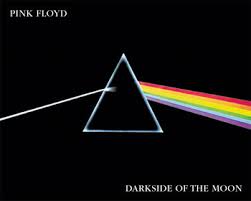
Pink Floyd’s Money lyrics (first stanza below) from their album Dark Side of the Moon reflects the dilemma with the almighty dollar:

Pink Floyd Dark Side of The Moon album cover
Click the cover to order from amazon.

Money, get away
Get a good job with more pay and you’re O.K.
Money it’s a gas
Grab that cash with both hands and make a stash
New car, caviar, four star daydream,
Think I’ll buy me a football team
Money get back
I’m all right Jack keep your hands off my stack.
Money it’s a hit
Don’t give me that do goody good bullshit
I’m in the hi-fidelity first class traveling set
And I think I need a Lear jet
Money it’s a crime
Share it fairly but don’t take a slice of my pie
Money so they say
Is the root of all evil today
But if you ask for a rise it’s no surprise that they’re
giving none away

In a prior On-Purpose Minute titled, “How’s Your Trust Account?” I invite viewers to consider where their trust is located … really.

Previously, I asked you to consider what you would do differently with $100,000 in your pocket.

Money will become whatever you choose it to become.

Will you become a slave to it or will you be the master of it? Come to terms with your attitude toward money. Money can be a source of great confusion and consternation. It can also be a source for provision and blessing.

Money can help you be on-purpose! Every time you use it, ask yourself, “Am I spending or am I investing this money?” Then consider if you are spending time or investing your time.

Ask yourself this simple question: What is money to me? Now you’re invited to chip in below with your comment to the question: What is money?

Let me hear from you!

Be On-Purpose!
Kevin

P.S. Perhaps you remember this “Show me the money!” scene from the movie Jerry Maguire.

What Are You Worth?

June 12, 2018 By kwmccarthy

No, this On-Purpose Minute isn’t a financial net worth kind of question! Much is made about self-worth and self-esteem, but preceding these is inherent worth.

Have you ever considered yourself as having inherent worth for just being who you are?

Many people are asking, “How can I find more self-confidence?” The underlying question isn’t a matter of gaining more self-confidence. First it is a matter of having confidence in one’s basic humanity, reason for being, and, as the U.S. Declaration of Independence describes them, “certain unalienable rights.”

We hold these truths to be self-evident, that all men are created equal, that they are endowed by their Creator with certain unalienable Rights, that among these are Life, Liberty and the pursuit of Happiness.

Are you prone to place conditions or performance standards on yourself to establish your worth as a human being?

Conditional worth, esteem, or love always fall short because they are based on external or environmental factors, beyond our control. Whether such conditions are self-imposed, learned, or simply cultural they’re limiting and limited and ultimately don’t serve us well.

Even the self-improvement business can’t solve your challenge if you believe you don’t have value from the day you were born to today and into tomorrow.

What does it mean to truly accept your inborn value?

What are the implications for you if behind all of your impressions, experiences, education, achievements, and performances you’re still empty in the end simply because you grip to a notion that somehow you “don’t deserve it”? Share your thoughts in the comments sections below.

This On-Purpose® Minute invites you to explore your inherent worth and to accept your unconditional love. Scrape away the accumulation of lies, shoulds and oughts, put-downs, and abuse to reveal the depth of your being. Explore what you really believe about yourself and your worth in your heart of hearts.

Your inherent worth journey promises to be a valuable experience, albeit it may be a painful one, too. Appreciate how to do more than just build your confidence and to understand and accept the wellspring or source of your confidence, worth, and value just for being you.

There is a reason the tagline for the personal leadership offerings of On-Purpose® begins with “Be Yourself.” Implied in “Be Yourself” is coming to positive terms with who you are. This is more than just accepting yourself for who you are. It is to joyfullyOn-Purpose Logo tag w color embrace the extraordinary and spectacular supernatural reality that you even exist and that you have a reason for being. Your 2-word purpose is a simple key unlocking the remarkable truth of your existence.

Yes, you may need to step far back from where you find yourself today to prospect for your intrinsic value. Do it! Don’t settle for seeing yourself as fool’s gold when you have a 24-karat heart and life buried within begging to be discovered and explored.

Be prepared, however; the exploration of your inherent worth leads to a way where forgiveness and grace will be necessary to both give and receive. It will inspire improvement and intrinsic motivation to be and become. Inherent worth is best realized with a change of heart toward God, self, and others … in that order.

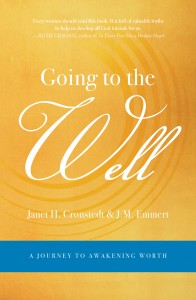
Going_to_the_Well_Cover_front

Women: Recommended Reading

Janet Cronstedt and J. M. Emmert co-authored Going to the Well, a modern parable set against the Bible story of the Samaritan Woman at Jacob’s Well. Explore the many issues of self-worth and inherent value through this easy reading message that will ring true especially for women. Men, if you care about your wife or daughter, then read this to better know how to be a man for the women in your life.

Powerful insights and understanding found in Going to the Well can lead to healing and recovery from the many plagues of low self-esteem and worth. You can’t afford to keep living the way you are. Go to the well in order to become well, whole, and worthy.


From the Mind of Mel Kauffman (used with permission) in response to this On-Purpose Minute

Shyness

Great message Kevin,

One of the siblings of low self-esteem is shyness. I am attaching a writing called Shyness No More. There are so many hidden messages in this tiny paragraph.

So many parents mention that they have a child who is shy. Not true. No child is born shy or with low self-esteem. Shyness was added by inappropriate parenting. No two siblings are treated with the same parenting.

To me, the best method of shyness recovery is to consciously stretch your zone of comfort.

No book that I have ever read has explained the source of low self-esteem and a simple way to eliminate it.

Pass it along,

Mel

Shyness No More

I believe that shyness is a habit. Shyness is not in your DNA. Shyness is not in your genes. Scientists have not been able to isolate one shyness molecule. Being shy is instilled. A newborn in the nursery is not shy. The newborn will do what it needs or wants to do without shyness or hesitation. Soon when the newborn becomes a small child a parent will utter, “My child is shy.” The parent will utter these words in front of their child. How sad. All of us seek attention. Soon the child will realize it is getting more attention by being shy, then the child becomes shyer. How sad. When the child becomes an adult it seldom speaks. Speaking becomes emotionally painful. Anais Nin wrote, and then the day came when the risk of remaining tight in the bud was more painful than the risk it took to blossom. Neale Donald Walsch, who wrote Conversations with God, penned these words: life begins at the end of your comfort zone. So in order to have more life a person must enlarge their comfort zone. One way for your zone to have a larger circumference is to be pushed. Mother eagle commanded her eaglet, “Come to the edge.” The eaglet said, “I am afraid.” Mother eagle admonishes, “Come to the edge.” The eaglet once again said, “I am afraid.” She pushed. The eaglet soared! Wouldn’t it be delightful to soar out of your shyness into a world that is waiting for your words? Ralph Waldo Emerson had another suggestion: do the thing you fear and the death of fear is certain. William Shakespeare over 400 years ago gave us this thought: act the part and you become it. Shyness recovery is a decision. When you reach the age of self-reliance, you will decide.

Mel Kaufmann

(1921-2018)


19 Ways to Conquer Low Self Esteem

Above is an interesting article with a diversity of ideas and points of view on low self esteem sourced by Jordan Ring.

Why Does Change Management Fail?

June 7, 2018 By kwmccarthy


What is change management’s greatest failure?

I am a contrarian about change management. It is just plain sloppy, imprecise language by the manager to describe a process and not an end result. The strategic work and a meaningful communication and action plan are missing. In the end change management invariably whips the corporate culture into a phase of unneeded confusion resulting in lost productivity and broken momentum.

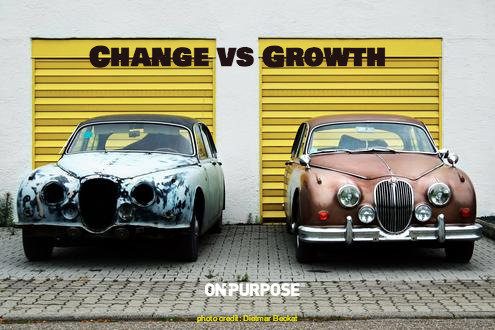
There is a better way—growth management!Rusted Cars

Change management is too often the latest in a line of misguided management marketing ploys to justify their efforts and position themselves to employees and shareholders as being on top of the business when they’re not. The employees know better and the shareholders are too distant to recognize the deficit of details being sold to them as strategy and leadership.

Change management is used at every level in organizations where two or more persons form a team. Supervisors to CEOs use the word “change” as a subtle form of control. Change management is a “wonderfully” accepted and euphemistic term in the general management business community for “a bunch of people (but not me) are going to pay a price for what’s getting ready to happen in this company.” Change managers use a variety of terms to disguise the stark reality that they are imposing their will upon their team and the consequences will fall upon the team.

Per Wikipedia, the definition of change management is “… any approach to transitioning individuals using methods intended to redirect the use of resources, business process, budget allocations, or other modes of operation that significantly reshape a company or organization.”

True translation:

Change = everyone else is going to accommodate what the change agent is saying and that person is just trying to figure out a way to break the bad news to you but doesn’t have the guts to speak plainly.

Amazingly, change management is the name of courses in business schools with professors and degrees focused on it. Major consulting firms have entire practice areas focused on it. Yet it remains a misdirection and distraction to the health and well-being of organizations.

As a business person or business leader, change is a word that you need to take as a warning to your own management approach. When you talk about change, it means the leader is either unclear about his or her vision or is unwilling to state it clearly. The subjects of the change, who are often far too trusting or at risk of challenging, will eventually learn whether the change was for good or for bad.

Regardless of the venue, leaders who market “change management” are as laughable as the emperor’s new wardrobe. The “beauty” of change is that it offers no measurable result, direction, or accountability.

Change can be negative or positive.

It just means something will be different, period. Well, of course, something will be different. Don’t settle with change—clarify what it means and where it is leading. Know the direction. Understand the destination.

Change is blind strategy with an escape clause for the change agent but rarely for the recipients of change. In reality, expect decline unless luck prevails!

The Power Option: Growth Management

Change is risky business. Few of us like change. Yet change, like breathing, is a fact of life.

Instead of change, let’s make the standard one of growth management.

Now the business person (or CEO) is focused in an upward direction and has a measurable result with a charge to add value instead of an ill-defined, open-ended nothing strategy that’s likely to result in decay rather than in growth. Decay is easy—do nothing. Growth, however, requires rolling up one’s sleeves, yanking out the weeds, and nourishing what’s discerned and defined as desirable.

Growth can include profits, behavior, people, relationships, and morale. Change is ultimately unaccountable babble left to the discretion of the leader making the change and an empty vision. It may sound inspiring, but it is merely sleight of hand illusion.

Growth requires a proactive partnership of time, money, talent, and a host of other factors coming together to a common cause. Growth is still a broad term that, like beauty, is in the eye of the beholder. It does, however, call forth cooperation, effort, and something of a more positive and productive nature on the personal, professional, and organizational levels.

Here’s a simple example. Pretend your boss walks in and says, “Let’s talk about a change I’m making to your paycheck.” What’s your response? You’re sure a pay cut is coming. You anticipate that your job or territory is getting ready to be reduced or eliminated. Am I right?

Now let’s imagine your boss walks in this time and says, “Let’s talk about a growth I’m making to your paycheck.” Growth has replaced change. Now assuming your pay stub doesn’t have a tumor, in the second example, you’re getting engaged and excited because your boss is communicating that plans are in process for a raise and an explanation for your coming reward. Economic growth and development trump economic change (and decay).

The mere act of replacing one word makes all the difference. Change is an implied downer. Growth is an exciter.

My suggestion: only use the word change when describing what’s in your pocket after buying your Chick-fil-a lunch any day of the week except Sunday. Change is apropos when reporting on the past. It is not a strategy for the future. Be in the business of growth and you will more likely be on-purpose.

Learn more about how to strategically and effectively create a pathway for growth management and value creation. Watch The On-Purpose Business Plan 9-minute instructional video.

Why Do You Work?

May 31, 2018 By kwmccarthy

How many times do you say, “I’m off to work”?

Does saying that conjure up light bulb with quotation "Are you being and becoming, or just selling out?"emotions of joy and excitement, or do your teeth clench and does your stomach churn and turn?

Your answer to this question goes to the heart of your life, health, and well-being in your spirit.

  • Are you one of the fortunate people who loves their work and has skillfully integrated (not “achieved” a work–life balance) the lines between work and life?
  • Have you become so fully integrated that you are on-purpose in business and in life? Are you compromising or being conditioned for your next great assignment?
  • Are you selling your soul or sailing along on-purpose?

Lots of questions for you to ponder.

Does thinking about this sound like work to you?

Sooner or later you will either answer the questions or pay the price for not answering them.

Got a comment to make? Go for it below. Let me hear from you.

Be On-Purpose!
Kevin

Have You Bought A Lie?

May 29, 2018 By kwmccarthy

Have You Bought a Lie? If so, it’s time to put it in the trash.

In the video portion of this On-Purpose Minute, I describe the “IABC” four types of lies we hold on to for all the wrong reasons.

  • Image
  • Attitude
  • Belief
  • Concept

Words are creative. Words come to life.

Many of us have had lying or hurtful words spoken into our lives in our innocence and/or in our adulthood. What we do next is up to us. Here are some tips to being whole.

Welcome truth, thirst for it, accept its pain, and embrace its liberation. In helping people to be on-purpose, I frequently come against seemingly irrational and obtuse behaviors from otherwise very accomplished and respected persons even in the face of contrary evidence. It’s their “old stuff” and patterns haunting their present and diminishing their future.

Why?

Words, more precisely lying or hurtful words, spoken into ourtruth lives by those closest to us or in whose care we depend strike hard on the soul. Lies falsely tarnish our self-image, attitude, behavior, or concept.

We pay dearly … for life unless we intervene. Holding on to the wounding is like tearing off a scab day after day and wondering why it doesn’t heal. The first offense is not of our making. The second offense, however, is all on us.

Forgiveness is the key.

Judith and I have an expression about forgiveness. “Forgive now and pray for sincerity to come later.” Forgiving someone who has hurt or offended you can be extraordinarily difficult, even painful, but it is the ONLY pathway I’ve found to MY recovery. It may or may not lead to reconciliation and recovery, but at least the injury stops hurting so much and with time, 99% recovery is possible.

Weighty Matters

Perhaps you think these self-deceptions or denial of damage are harmless? Hardly! They can literally have life and death consequences.

For example, within the health coaching team of On-Purpose Partners, we find the following kinds of Images, Attitudes, Beliefs, and Concepts can prevent clients from being qualified candidates for success in our program.

  • Image: I can’t imagine myself at a healthy weight anymore.
  • Attitude: I know what to do; I just don’t do it.
  • Beliefs: My family has always been big.
  • Concepts: I just don’t get enough exercise.

These mythologies of weight loss are factually inaccurate and crippling to us being in a healthier place. Even clients with the deepest desire to get healthy will scuttle their success unless and until they are aware of their personal mythology and clinging to old wounds that affect their well-being today. Coaching clients to health is more about their life experiences and views than it is our program. The program works, but will the client work the program?

You’ve seen the price of pain! Most of us are emotional abusers of some “drug of choice,” such as food, alcohol, smoking, drugs, shopping, or a host of other addictions. Think there isn’t pain? Ashley Madison had 36 million paid members who knowingly were seeking discreet affairs outside of marriage. Consider the trauma of a divorce, pain to the children, and the lawyers’ bills.

Lies are the words that keep on taking.

Lies we buy make it that much harder to sell our ideas, opportunities, and opinions. Lies steal from our livelihood and sap our worth. Lies corrode our productivity and undermine our careers.

Are you ready to uproot lies with greater truths? It begins by being open to living in truth. With truth comes greater freedom and abundance.


Do you have a coach or a health coach? Then share this On-Purpose Minute with them. Consider giving them permission to help you identify any lies or festering wounds. Ask them to help you work through forgiveness of the offending party, even if it is you.

Counselors and clergy are great sources of recovery. Clergy are especially versed in the area of forgiveness.

Do you need a coach? Certainly we offer life coaching to unburden your image001spirit and health coaching to relieve your joints and back from the physical burdens weighing on you. Contact Judith McCarthy for a free health coaching consultation so you, too, can get to your healthier place.

Am I A Natural Born Leader?

May 22, 2018 By kwmccarthy

6a00e551c6499c8834019affa9fcd9970b-320wi.jpg.jpg
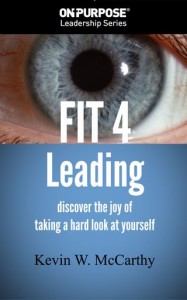
Click on the book cover
to buy FIT 4 Leading
from amazon.com

Decide to discover your inherent leadership capacity and your obstacles.

You’ll transform your life plus the lives of those around you presently and those to come. Shuck the shackles of being a victim and grasp the freedom of being yourself, prospering, and making a difference … on-purpose. Yes, it can be risky, but it is better than living life in a fragile glass jar.

Discover the joy from taking a hard look at yourself.

In my book, FIT 4 LEADING, this haunting question of natural born leadership is addressed. Below is an excerpt from the book from Chapter 9.

“Many of us think that leadership is like athleticism—either you were born with coordination or not. This thinking emerges because of this ridiculous debate around the question: Are leaders born or are they made?

“Here’s the final word on the question: Yes! It is both.

“Leaders are born and leaders are made. You were born to lead.

“What you’ve made of or how others have helped fashion or develop your leadership may be a missing refinement, but the raw material of your existence is designed for leading.

“What? I was born to lead? But I never thought I was …

“Yes! You were born to lead, period—end of story. Take this as fact.

“How can I unequivocally state to you that you were born to lead? It is because I know you are especially fit for leading. You have a unique design and purpose in your life that is unlike any other person.

“Isn’t the real question: How can you not be fit for leading? The evidence is overwhelmingly clear if you’ll look at it. You have this good fortune of a Body, Mind, and Spirit that has an absolutely incredible capacity for expression and becoming. In fact, it craves to productively come alive in ways you aren’t even imagining, especially if you’ve relegated yourself to follower status.

“A subtle distinction is needed here. Being a leader versus being a leader in a given situation is different. The President of the United States of America is the leader of the free world. That’s a large domain. But if the President is hosting a reception for a visiting President of an allied country, and his guest falls to the ground with a heart attack, the President is no longer the leader in that situation. The doctor from the crowd who emerges immediately becomes the leader of that situation. The U.S. President is relegated to the role of bystander.

“Leaders understand that they step forward in some situations and take a backseat in most. Those who think otherwise are just arrogant people who are egomaniacal control freaks. Only needy minions and groupies will follow them. Strong leaders have strong followers.

“If you believe anything other than the fact that you were born to lead, then you’ve bought a lie spoken upon your life. However it got there doesn’t matter anymore. Stop living into that lie now! Choose to be the leader of your life. Otherwise, you’re the one who is paying the price. Someone other than you is benefiting from it at the expense of your Body, Mind, and Spirit.”

Visit the FIT 4 Leading website. There you can read the first chapter of the book, watch a free 30-minute webcast, and much more. Softcover and Kindle versions are available on Amazon. Use Prime for free shipping.


So How Are Your Shortcuts Working?

May 17, 2018 By kwmccarthy

Shortcuts are almost always shortsighted.

The pressure to produce immediate cash flow in business can tempt one to take shortcuts or put in minimal effort. I’m not talking keyboard shortcuts, fraud, or other illegalities here. We’re talking cutting corners in order to shade performance lightly to hit a short-term goal. While not illegal, it is a bad business practice that dampens future opportunity.

One trait of a true leader is the ability to make the call between the short-term effect and the long-term consequences. Knowing when something meets standards, however, is different from cutting corners.

One might think that doing right is a matter of business ethics.

Ethics, however, begin by having a heart for caring, honesty, courtesy, and a desire for a life well lived, even if it costs a few coins at the moment.

A few years ago, I bought a used iPhone from a retail store here in Winter Park. I was mid-contract with my cell carrier and my mobile phone was failing. I thought I would give an iPhone a try, especially since I was a longtime Mac user.

At the store, I put my name on a list to get a used one. I got a call to come see it. Lay cornerstonesThe salesman in the store showed me the phone. The phone checked out—looked nearly new with no scratches to the back or front. It was in the box. Dropped in my SIM card and it worked like a charm. I got home, however, and the charger was rejected by the phone. That’s odd!

I returned to the store and get the tech guy, not the sales guy. Turns out the sales guy who sold me the iPhone yanked the OEM charger and replaced it with a cheap version that didn’t work. That little cube costs $30 to buy. The tech guy told me, “Yeah, I don’t know why he (the sales guy) does that,” as if this wasn’t the first time! But he can’t do anything about it. I walk out unhappy.

The sales guy cut a corner on me! And he nearly got away with it. If the phone hadn’t known the cube was a knock-off, then I wouldn’t have known any differently. I trusted him and got shortchanged.

Thinking I had found a great little local business to support, I was prepared to recommend this store to several friends. Now I’m cautious because a corner was cut.

Later, I returned to the store, talked to the owner, and was immediately given an Apple charger. Kudos to the owner who mitigated some measure of the damage to his business reputation. Then again, why does he have a “corner cutter” like that working there?

I’ve never sent a person to their store.

A few years back, I had the pleasure to interview Philip Crosby, author of Quality is Free. In essence, this thought leader of the quality movement in the 1980s had a simple message:

“Do it right the first time. It costs too much no matter what to make it right after the fact.” Crosby proved the cost of cutting corners doesn’t pay.

Little people cut corners! Real leaders lay cornerstones.

Which are you?

Are You Owning Your Mistakes?

May 15, 2018 By kwmccarthy

Mistakes are inevitable, yet the fixation on perfection in our society is debilitating.

Whether it be lawmakers, bakers, payroll makers, or homemakers, the fear of making a mistake can flatten one’s life into a “safe zone” of mediocrity. Risks and loss are inevitable when one ventures into life or work with a sense of wonder and discovery. You are better off to have a mistake than to miss-a-take at what could be.

It is a mistake to view mistakes as merely mistakes.

Instead, mistakes can lead to retakes and become invaluable guideposts to life and growth of one’s personal growth and leadership. Mistakes open doors to learning or blaze new pathways that might otherwise go undiscovered.

  • “Mistakes” enabled Thomas Edison to discover 9,999 ways a light bulb couldn’t work. And in the process, he developed a reliable means of tracking research and increasing his knowledge of elements.
  • “Mistakes” created the Post-It® Note. “Mistakes” often open doors to new frontiers of thought, use, and development.

Just Say It!

“Yes, that’s my mistake.” These are the four magic words that when said sincerely are your path to a healthier and happier life without the stress and strain imposed by the pride of perfection and the need to be right. It will take practice and some hard swallowing, but you’ll be amazed at how much simpler life becomes.

Problem ownership is your best chance to open the door to mercy, grace, and forgiveness. The risk of owning up has a downside of consequences, but it also has the upside of building trust and rapport. In practical terms, when the mistake is out in the open versus covered-up, a solution or fix will happen sooner and with less cost.

Take Your Mistakes Like A Leader

When we make a mistake, our natural reaction is to be defensive. We retreat and distance ourselves from the mistake and then look to whom we can pass off the blame. Shedding responsibility for a mistake may momentarily soothe the psyche, but each pass of the buck creates a self-inflicted bite upon one’s soul.

Admittedly, most of us prefer to cover our mistakes under a blanket of embarrassment, shame, or self-pity. Stopping dead in our tracks at our mistakes to point fingers at people, circumstances, and systems invites a bitter and negative stronghold to enter our emotional and spiritual system. We’re stuck in a self-imposed unhealthy manner of living that taints every aspect of our lives. Now that’s a tragic and true mistake!

Compounding our initial mistake with another more sinister mistake knits a habit of ill-fitted denial into the fabric of our lives.

Do this too often and we live in a straitjacket of fear of failure and bitter close-minded defensiveness. In time, the fear of exposure arrests our maturity and so we become the very thing we fear most—a dull and ordinary blank slate of a person with no distinguishing quality. We live small (which is different from living humbly). Repeating these actions and circumstances reinforces a debilitating pattern and fuels a vicious cycle of defeat.

Lincoln memorial cent, with the S mintmark of ...Image via Wikipedia

A Penny For Your Thoughts

Life need not be this way. Instead, what if mistakes are friends in the form of hard lessons? They’re not roadblocks, per se, but guideposts revealing a better way to navigate life. Mistakes can help us know who we are and what we’re called to be about with our special gift of time on the planet.

Mistakes are an odd currency of redemption. Their true value comes with a cost in the form of a workout where we have to face ourselves. Throwing “good money after bad” is viscerally upsetting. We’ve been given an intellectual and spiritual capacity to rise higher and dig even deeper to strengthen our condition regardless of the proposed outcome. It only requires us to admit our mistake and gain the clarity and opportunity to set things right—stronger and better than before in some cases.

Wisdom is often the byproduct of mistakes, provided we invest in processing the lessons to be learned. Here’s where a mentor or coach can help us reflect and grow. If you’re seeking that mentor or coach, perhaps we can help you?

  • « Go to Previous Page
  • Page 1
  • Interim pages omitted …
  • Page 3
  • Page 4
  • Page 5
  • Page 6
  • Page 7
  • Interim pages omitted …
  • Page 10
  • Go to Next Page »

Footer

Search this site.

  • Making Meaningful Money™
  • Leadership Mettle™
  • Booking Kevin
  • About Kevin
  • Endorsements

Copyright © 2026 · Kevin W. McCarthy, Winter Park, FL