• Skip to main content
  • Skip to footer

Kevin W. McCarthy

The Professor of On-Purpose

  • Book Kevin to Speak
    • Programs
    • Be On-Purpose®
    • Making Meaningful Money™
    • Leadership Mettle™
    • TOUGH SHIFT®
  • About Kevin
    • Endorsements
  • Blog
  • Search

Strategy

Overextended: The Moment Success Starts Turning Against You

February 5, 2026 By kwmccarthy

Part 3 of the Success Without Selling Series

There’s a moment most A-list, high performers don’t see coming. You’re still succeeding. Still producing. Still getting results. From the outside, nothing looks broken.

And yet something quietly shifts.

The work that once energized you begins to drain you. The life you built starts demanding more than it gives back. You wake up tired before the day even begins. You move faster, but feel slower inside. You’re doing good work — but you’re no longer certain it’s your work.
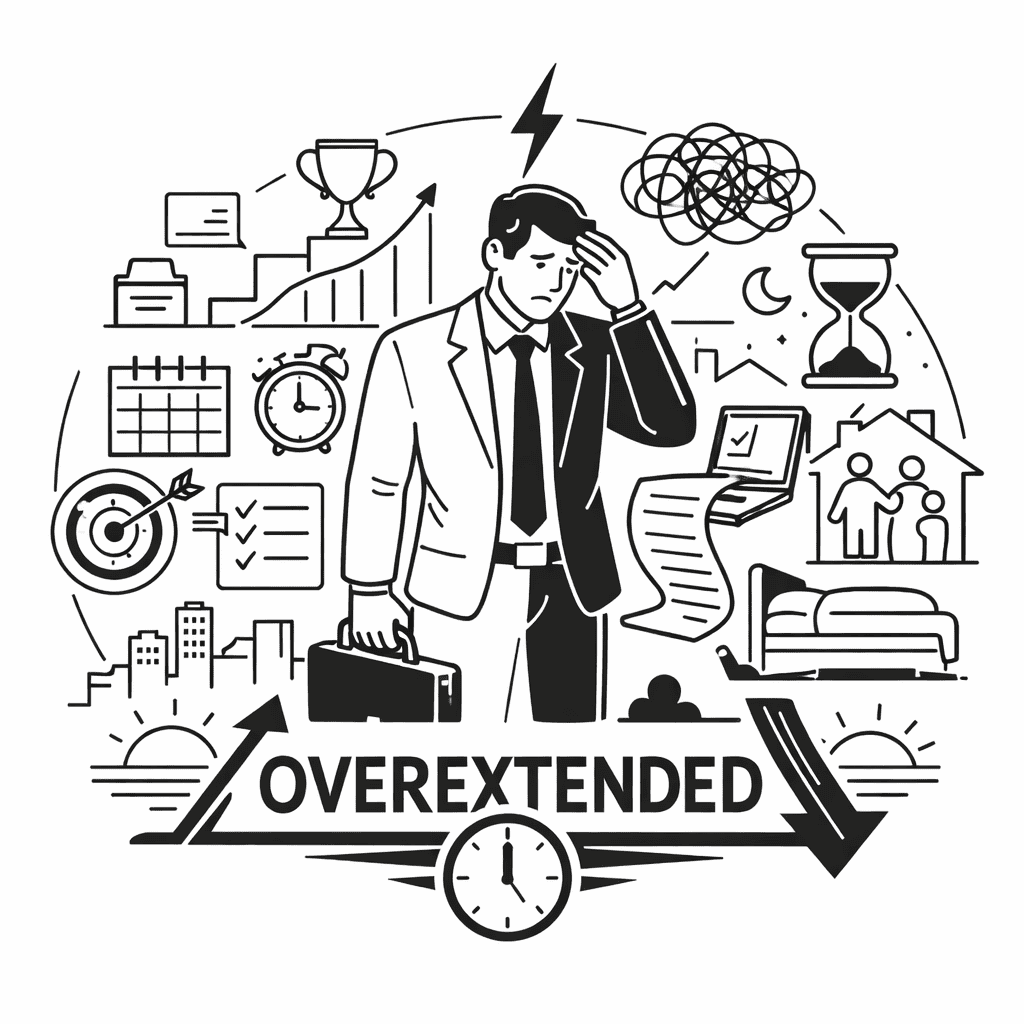
Businessman overwhelmed by stress and chaos, symbolizing overextension and burnout.

The work that once energized you begins to drain you. The life you built starts demanding more than it gives back. You wake up tired before the day even begins. You move faster, but feel slower inside. You’re doing good work, but you’re no longer certain it’s your work.

At first, you tell yourself this is just a season. Another sprint. Another quarter. Another push. But seasons come and go. Your overextension stays and grows increasingly more demanding.

When will your breaking point happen?

Here’s the paradox: you’re NOT overextended because you’re doing the wrong things. You’re overextended because you’ve been doing too many right things for too long — without a clear personal strategy for renewal, recovery, or recalibration. You’re selling out your self to your work, cause, or ministry.

That’s the subtle trap of success.

Early in your career, hustle served you well. Hard work built credibility. Responsiveness created opportunity. Reliability opened doors. You learned to say “yes,” to deliver, to perform, to show up.

And it worked.

But the habits that helped you rise can eventually become the habits that wear you down.

You become efficient.
Then efficient becomes relentless.
Then relentless becomes exhausting.

Before you realize it, your life is driven more by momentum and profit than by meaning and purpose.

This is where high performers get stuck — not in failure, but in success without order.

You’re not lost. You’re overloaded.
You’re not drifting. You’re stretched too thin.
You’re not lacking discipline. You’re lacking direction.

Even Jesus knew how to take a break. Most overextended people don’t need more effort. They think they need more rest. What they need is whole life strategy. Think of it as way to discharge in order to recharge.

In the On-Purpose way of thinking, overextension is usually a symptom of misalignment between four things:

Your Purpose — why you exist.
Your Vision — where you’re going.
Your Missions — how you spend your time.
Your Values — what truly matters.

When these are clear, your energy naturally flows in a meaningful direction. When they’re vague or crowded out by urgency, expediency and your calendar start running your life.

Here’s how overextension typically unfolds.

First, your outer life expands.
More responsibility. More influence. More opportunity. More expectations. More people depending on you. More doors opening because you’re capable. Success! You’ve arrived.

Then, your inner life contracts.
Less margin. Less silence. Less reflection. Less joy. Less presence. Less sense of who you are beyond your roles.

You’re still impressive on the outside — but smaller on the inside.

You begin to live tactically rather than strategically. Your days become a series of reactions: meetings, emails, fires, requests, decisions, deadlines. You move from task to task, but rarely step back to ask the deeper question:

Is this life I’m building actually the life I want to live?

Overextension isn’t cured by time management. It’s cured by knowing who you are deep down.

You don’t need a better calendar.
You need a more solid cornerstone to your existence.

In my work with the highly successful, I often see three quiet warning signs that success is starting to turn against them. Test yourself:

  1. Your energy is thinning.
    You’re not burned out yet — but you’re no longer lit up either.
  2. Your relationships are getting leftovers.
    You show up physically, but not fully.
  3. Your decisions are reactive.
    You’re solving today’s problems with quick fixes with less regard to shaping your tomorrows.

None of this means you’ve failed. It means you’ve outgrown your current way of living.

Overextension is not your enemy. It is your signal. It’s your life inviting you back to purpose. Back to order. Back to intention.

The way forward is not to do less randomly. It is to do more of the right things more intentionally. Start by clarifying your 2-word purpose — the simple statement of why you exist. When your purpose is clear, your decisions get simpler. You say “yes” with conviction and “no” with peace.

Then be strategic instead using hacks. Articulate your Vision, your Missions, and your Values so your time serves your life, not the other way around. Invest your remaining years instead of spending them.

Finally, make your declaration to live on-purpose rather than overextended or some other off-purpose detour.

You don’t need to quit your job.
You don’t need to dismantle your life.
You need to reorder it around who you truly are and want to become.

Overextension is not your destiny. It’s a chapter, not the story. You get to write the next chapter and the next chapter after that. Or, you can bookmark your life today and close the book on your life.

Download A 3-Step Guide for Being On-Purpose®. It’s a simple way forward so you can enjoy your success without selling out.


When Success Starts to Feel Like Selling Out

January 27, 2026 By kwmccarthy

Man sitting at a cafe window overlooking a bustling city street with taxis and pedestrians.

What happens when from the outside, your life looks good; your work and you are highly respected; your calendar is full, your income is solid; you’re productive, reliable, and admired; and by most measures, you’re succeeding.

But something is off. “Selling out,” in this context, isn’t a matter of greed, moral failure, or succumbing to bribery. We’re not talking sinister motives. You’re a good, upstanding person.

Nothing dramatic happened. Nothing was suddenly broken. It’s just this persistent unsettling sense that something feels out of order in your approach to life. 

Selling out is something subtler and all too common. It is more like “How did I end up here?”

What “Selling Out” Really Means

Selling out isn’t about making money or achieving success. It’s about small compromises over time that eventually led to being in a place never intended. Accompanying this can be a forlorn sense of a lost dream or an out-of-character fear of rocking the boat. 

Selling out involves quietly exchanging something (or someone) that truly matters, such as your values, your standards, or your sense of self for external rewards like approval, status, or security. What’s fleeting is chosen over the enduring. 

It doesn’t happen all at once. It happens in small, seemingly logical decisions over time with the compound effect catching up with you. It happens when you are:

•       Saying yes when your gut says no
•       Staying busy to avoid pondering deeper questions
•       Accepting work that pays your bills but drains your soul  
•       Engaging in entertainment while neglecting responsibilities
•       Convincing yourself “This is just how it is right now” 

From the outside, it plays as progress.
From the inside, it lands as distress.

What Selling Out Is Not

You can be successful, busy, and well compensated without selling out. Selling out is not lack of ambition or responsibility. It’s not forgoing your family or failing to get the job done.

Selling out only occurs when success comes at the expense of your identity and purpose. It happens when what you’re doing no longer reflects who you are or who you’re becoming. And it eats away at your spirit and you start disliking who you are becoming. 

The Quiet Warning Sign

The most reliable signal that you’re selling out isn’t guilt or stress. It’s numbness, a secret apathy that’s set in. You care, but you really don’t care. The emotional disconnect is real. You’ve fallen out of love.
You stop asking Is this still worth it? And you start asking Is this how I want to live the rest of my life?

You discount those questions with But I don’t really have a choice.
That’s when settling and accepting has become your unsettled way of life. 

Why High Performers Are So Vulnerable

The problem is that your success keeps rewarding the very behaviors that created your disorientating condition. Your outer, public persona demands growth and expansion, while your inner life can’t keep up and quietly shrinks for fear of exposure.

It isn’t failure. It is success at something that no longer fits. It is climbing the proverbial ladder of success, peering over the wall, and questioning, Is this what I’ve been working so hard to achieve all these years? In other words, the reality didn’t meet the anticipation. 

Reframing Success without Selling Out

Success is no longer what you can accumulate. It’s become not betraying who you are. In a word: authenticity. No more faking it, impostor syndrome, or playing an ill-fitted role. You’re stepping up to be the leader of your life. 

Here’s six authenticity anchors:
1.     Integrity over optics  
2.     Sustainability over expediency  
3.     Stewardship over indifference  
4.     Meaning over materialism
5.     Strategy over trial and error
6.     Simplicity over complexity

Why On-Purpose

Being On-Purpose happens when success is defined internally and expressed externally with intentionality. Selling out happens when success is predominantly defined externally.

Don’t step back. Don’t abandon ambition, making money, or career advancement. Far from it. Roar into the marketplace. However, step up. Broaden your definition of success so your inner life can comfortably sustain your outer life. Grow up by getting your life in order, on-purpose. 

Be On-Purpose!
Kevin

Download for Free:
A 3-Step Guide to Being On-Purpose: Success without Selling Out

Daring Business Owners to Profit the World

May 19, 2023 By kwmccarthy

Why does your business exist? Pause and answer. 

Business owner holding cash with sunglasses, promoting profit and success in entrepreneurship.

Over the decades, I’ve posed this question to business leaders and audiences. Here’s the four most popular and consolidated responses of my unvalidated survey:

  • 50% to make money or to profit the shareholders
  • 20% to sell goods or services to customers
  • 20% to provide jobs
  • 10% to raise the standard of living in society

So what did you answer?

The first three accurately describe what businesses do (missions), but not the reason why businesses exist (purpose). Confusing missions as purpose creates an “it’s all about me first” approach to leading a business. Such a self-centered orientation distorts the business and ironically diminishes performance. 

Unfortunately, this is the prevailing principle at work within the CEO-system of business administration. Most business owners are unwittingly placing mission ahead of purpose from ignorance, not malice. Regardless, the adverse effects remain the same.

Purpose provides a point of origin to meaningfully resolve, satisfactorily align, and fluidly blend otherwise competing interests in service to God, self, and others. Purpose (being) informs vision (seeing) and is expressed through its missions (doing) while guided by its values (choosing).

Businesses hold the special opportunity to profit (add value) to the world’s people. Business is first a social construct whose greatest potential to earn, sell, and hire ultimately relies upon improving the lives or standard of living of people — shareholders, team members, customers, vendors, and more. This common good mindset is akin to answering the question, “How does our business make a difference or the world a better place?”

If your business doesn’t have a 2-word purpose, you’ll find in Chief Leadership Officer the suggestion to use “We exist to serve by Increasing Wealth.” One caveat for using wealth (state of weal or well-being) is to embrace the whole person perspective (body, mind, spirit, and financial) plus working and living conditions — one’s standard of living. 

My bet is you don’t have a purpose statement. Rather you have a vision or missions and you’ve haven’t a clue what its costing your company in lost financial profit.

Business has a high and noble role to play in society. We are to profit the world–to make the world a better place. I dare you to re-consider how your business purpose is stated, communicated, and integrated throughout your company.

Let your business reformation begin!

Be On-Purpose!
Kevin

PS: Need some help sorting out purpose, vision, missions, and values. Schedule a time to Pick Kevin’s Brain.

Are You a “Daring” Entrepreneur?

May 2, 2023 By kwmccarthy

 In the title, “Daring” is in quotes because we entrepreneurs may be risk-takers but we’re not gamblers. The beauty and artistry of launching a business is that a person can start with nothing more than an idea and bring it to life to enrich peoples’ lives. Daring, however, is best left for daredevils not founders.

Entrepreneurs typically operate in one of the following seven stages. Knowing this prepares you for your journey.

  1. Contemplating: What will it take to quit my job and start a business in my search of independence, opportunity, and wealth?
  2. Enraptured: In the “hands on” start-up of organizing the business — the honeymoon stage.
  3. Captured: All time, money, attention, and energy are imprisoned by this relentlessly needy foundling. 
  4. Emerging: The founder of this thriving business says, “Why didn’t I start this years before?”
  5. Expanding: Scaling a team, culture, and brand. 
  6. Exiting: Who will replace me as the leader?
  7. Exited: Moving on to what’s next.

Navigating from stage 1 through to stage 7 involves integrating an increasingly complex variety of disciplines. Each stage opens to frontier territory with a wondrous confounding set of challenges and learning experiences. Some of these roadblocks will bog down the emerging business leader for days to decades. The School of Hard Knocks carries a high cost of tuition. There is a better way!

May I serve you? I am a lifelong student of business and leadership. I began as a nine-year-old entrepreneur selling candy on the school bus. Business degrees plus a series of failures and successes decades later, authoring bestselling books, and advising top decision makers in all seven stages has honed my talent to cut to the root cause. It’s a jagged path with ups and downs but I can help you flow more fluidly from stage to stage.

Don’t be daring. Work smart. Set your company and team up for success. Recognize financial profit is a net result and not your reason for being in business. Build from your personal 2-word purpose toward the vision in your mind’s eye. Organize, delegate, and serve, and you will likely realize what you set out to achieve and then some.

Be On-Purpose!
Kevin

PS: Got a Puzzling Problem?

Book me for a prepaid 45-minute business growth session. Satisfaction is guaranteed or your money is returned. Learn more at  www.PickKevinsBrain.com

How to Name (or Rename) Your Business Right for Success

April 18, 2021 By kwmccarthy

Creating a Right Business Name

Keep Your Business Name As Simple As Possible

Business naming is a combination of art and science. Done right, it sets your business up for long-term success. How? A good business name eases the marketing and sales process, builds customer and team member loyalty, and provides a strong ROI.

If your business name isn’t helping you, then it’s hurting you. Why settle for anything less? Let’s get your business name right from the start-up, or rename your business to gain a host of business advantages.

Business naming is a big subject. Let’s focus on the start-up entrepreneur and the small-to-midsize business owner. Large corporations typically turn to their internal marketing team, an outside ad agency, or strategy consultants like On-Purpose Partners for this work. Because you’re reading this, is it fair to assume you don’t have $1 million like Pepsi spent in 2008 to change their logo?

Creating a right business name is first a strategic process. Start-ups have the advantage of the proverbial greenfield to start fresh. In an existing business, a business name change typically means something isn’t working with the current name. Perhaps you need a new name because your business and another are merging. Beneath a new business name, something strategic is in play.

Business naming problems fall into broad categories such as being too long, too difficult to spell, or too hard to remember or pronounce. It takes an extra investment of time, money, and effort to establish a difficult business name. However, once established, the business name can become distinctive. Here’s an article from HubSpot on hard-to-pronounce business names that you likely know.

Creating a right business name has practical implications. The business name will visually appear in print and in pixels. It will be in use everywhere. It will also be spoken on video, podcasts, radio, and other audio formats. It will be converted into a graphic for placement on signs, doors, trucks, business cards, stationery, banners, and more. Your business name is tightly tied to your brand strategy and implementation.

Creating a right business name has personal implications. For many owners, your business name is a reflection of you personally. In addition to the physical assets of your business, your business name lives as intellectual property with a goodwill value for when you sell the business or pass it on to others.

Creating a right business name has creative effect. Do you want a catchy business name, a cute business name, a prestigious-sounding company name, or (to the other end of the spectrum) a short, nondescript name that you build into a brand? Do you want your business name to be bold or subtle?

How to Get Your Business Naming Process Started

Business Naming exercise
Business Naming Brainstorming Exercise

Here at On-Purpose Partners, clients periodically seek me out to help them name or rename a business, product, or service. Because they recognize I’m gifted with distilling big concepts into a few words, as in a 2-word purpose statement, I’m a natural for this work. I’m remarkably fast and accurate at naming businesses, programs, products, and such. Pushing the boundaries of the mundane to get to something magical is really a blast! And, as a business owner myself, I appreciate what all is riding on the business name. There’s an urgency to get the business name in place sooner rather than later. Otherwise, the business is can get bogged down and kill precious time.

Here’s the way the business naming process works:

Initial Consult: This is typically a 30-minute over-the-phone or video call where we mutually assess fit and appropriateness. If both of us agree it’s the right fit, engage me via a Small Business Advisory Package (as long as your revenues are under $1 million). If you’re a larger company, then our next step is a consulting engagement with the On-Purpose Partners team that I’m leading. The fees vary based on the degree of complexity, which includes but isn’t limited to the size (sales and people) of your company, the stakes involved, the number and level of decision-makers who need to sign off, and the speed of your need. We only work directly with the company owner, president, Managing Director, CEO, or CLO.

Engagement: Ready to get started? Below is the typical flow of a business-naming engagement.

Prep Me: In advance of our interview(s), send me links to your current website and LinkedIn profile. This helps me get a sense of your company and you. If you have an existing product or service, if possible, I want to experience it. Send me your available product and current marketing, brand guidelines, or business plans. If none of these exist, no problem — we’ll talk it through.

Give me context. The nature of your business matters when it comes to business naming. For example, business naming for a B2B enterprise versus a B2C company typically defines a direction.

Prep You: You’ll be given access to use ONPURPOSE.me to find your purpose in life. The best small businesses are ultimately the expression of a person’s purpose and passion. Your 2-word purpose provides a solid basis to craft your business name and to assess if the business name and your purpose are meaningfully aligned.

Interviews: You’ll be interviewed about what’s working and what isn’t working with your business name as well as your business. It’s vital we establish a dollar value to renaming the business. It may not be worth it or it may be worth a lot. This metric is important. Otherwise, it is easy to put off working on the business. There are always pressing issues, and business naming is easy to put off. Here’s where my accountability to move the project along matters.

Once I’m prepared to meet with you, we begin a fun, exploratory process. My first question is, “What’s your gut tell you to name the business and why?”

You’ve been thinking about this for some time and I want your thoughts. Put your ideas out there. While you may not be gifted at business naming, you know your business. This is our starting point that tells me what you have in mind.

I’ll ask a number of related questions to assess the fit with your vision (where you envision your business going), missions (what you do), and your values (what is important to you). Surprisingly, we may be able to tweak what you have and be done in minutes. Business naming isn’t something you do on a regular basis so my best advice involves affirming your keen thoughts.

I may even throw a number of business names in your direction just to get a sense for your personal preferences and to hear your reaction. Ultimately, this is your business and you want to be proud of it. This fast, creative, instinctive process can produce remarkable results so you can get moving now!

The instinctive approach works best for start-ups and small businesses. This collaborative business naming approach gets to a business name thoughtfully fast. You’re relying upon my decades of business experience to absorb the spirit of your intentions and to translate that into an immediate and sustainable business advantage.

Beyond the instinctive approach is a more structured approach that most often comes into play for midsize or larger companies where lots of livelihoods are at stake. This typically involves a 30-day process and can range from thousands to tens of thousands of dollars, subject to complexity. At this point, you’ll have a written contract to sign.

If the instinctive process fails to produce near-immediate results, we move to a more structured approach. This is typically needed in midsize companies and larger.

Competitive Assessment: Give me the names of your top 3 to 5 competitors. I will assess how far behind or ahead you are of your competition from a strategic and marketing perspective for attracting and keeping customers and team members.

Set Criteria: Based on all I’ve learned, we’ll collaborate to create criteria to measure how well potential business names achieve the desired business goals and outcomes. For example, does LLC or Co. or Company need to show up in your business name? How long or short does the name need to be?

Suggestions: For existing businesses, we may write a briefing or produce a video to share that a renaming process is underway. Next, we launch a campaign to invite related parties (team members, customers, vendors), asking for their suggestions.

Collaborate to Create a List: Eventually, all those involved go away to just noodle on a new business name and send me their suggestions. I compile their suggestions, plus I do “my thing” as my team calls it.

I use a combination of internet research, the dictionary, mind-mapping, and conversations with consulting peers and creatives to come up with a list of names. During this creative process, I’m also searching for trademark and domain name availability so we don’t fall in love with a name we can’t readily use. I’m also searching for variations on the name, including misspellings. For example, Lyft, the shared-driving service, plays off the concept of giving some a lift or a ride somewhere.

Presentation(s): Depending on the size of your company and the number of decision-makers involved, I cull down the list to a reasonable number of business name options where we weigh the pros and cons against our gut and against the criteria. This may take a few rounds of whittling the list to the final selection.

A New Business Name!: Now that you have a new business name, this opens up a host of wonderful opportunities — plus work. You’ll need a new logo, an outreach campaign to announce your great news, and more.

Business Naming Lessons

Over my decades of doing this kind of work, I’ve learned a few lessons. Here’s a few:

Generally, the shorter the name the better. A short name works better for memorability, graphics, and efficiency in all communications. Simple sells better and faster. The more people can remember your business name, the easier it is for them to refer people to you.

Business naming is easier when business strategy is in place. At On-Purpose Partners, we help clients write their deep strategy of purpose, vision, missions, and values. These are defining statements that feed into the naming process.

Business naming draws upon the past while inspiring the future. Even if your business is a new start-up, you have a history that led to this point. You also have a vision for where you want it to go. And you need to act in the present.

Get it right the first time. Business name changes are a big deal. You don’t want to do them very often. Everything from filing a name change with state, federal, and local agencies to communicating with vendors and customers to graphics to banking and checkbooks and more are just some of the realities of a business name change. The corollary to this, however, is:

When your business name stops working for you, make the business name change fast. My father-in-law was a dairy farmer and had an expression about dragging things out: “It’s like cutting the tail of the dog off an inch at a time thinking it won’t hurt ’em so much.” Act and act decisively.

Digging deeply into your personal, career, and business history produces gold! By also exploring your dreams and aspirations, we’re more apt to land on a solidly meaningful name for your business. The added benefit of this is a significant strategic advantage because the purpose, vision, missions, and values of your business are clarified.

Decide if you’re building a practice, a lifestyle business, or a business. What’s the difference? A practice is a business a professional builds. A lifestyle business meaningfully integrates one’s life and work to where profit-making is one of several measures of success. A business is a serious, all-in endeavor with significant aspirations and ambitions that will employ lots of people and serve many customers. This relates to the purpose, vision, missions, and values of the business and its owner(s).

Founders matter. Founders insert a spiritual DNA into a business that sets a pattern and mindset. Sometimes that is good and other times it isn’t. For example, renaming may be necessary to reinvent the organizational culture.

Your business is its identity in the marketplace. The business name and your business strategy, marketing, graphics, sales, and team culture are all influenced. Investing in such a vital aspect of your business on the front end has very practical human, operational, and financial implications. It’s a small forward investment with dividends through to a retirement or exit strategy!

Do I use my name in naming my business? Yes and No!

Ford or General Motors? Post Cereal or Generals Mills? Hewlett-Packard or IBM? The first business name in each pair bears the name of its founder. The second group doesn’t. There is no right answer, just the one that best suits your needs. There’s also change. Edison General Electric Company became General Electric Company in 1892.

Here’s some guidelines and examples:

Are you a start-up solo owner who is a coach, consultant, counselor, trainer, lawyer, CPA, engineer, realtor, broker, architect or other role that’s providing professional services? If so, then using your name in the business name of your practice often makes sense.

If you’re a personality-based business, such as an author, politician, artist, solo musician, TV or radio personality, comic, keynote speaker, etc. and that’s your gig, then use your name.

Using your last name in your business is fairly typical but not necessarily all that inspiring. For example, if I were starting a business, I could name it McCarthy & Associates or McCarthy Company, if it is available. Typically, this business-naming method conveys a small professional service led by one person and perhaps a small team. Frankly, I find these names bland from a marketing perspective, but they may also reflect the personality or lack of marketing expertise of the owner. Ironically, it is truth in advertising.

On the other extreme is the Trump brand. Heck, it helped Donald J. Trump become the President of the United States!

My colleague, Terry Pappy, is a talented solopreneur business advisor. She formed PappyClub to help her peeps build their businesses and brands. She included her last name in the business name to convey that you’ll be hanging out with Terry as she coaches and offers business and marketing insights. She’s very sharp, quick-witted, and fun to be around so being in a “club” with Terry matches her style.

What about using your first name? I engaged the services of Jan & Susan, a virtual assistant team. Jan and Susan are the two founders who elected to use their first names in their business name. Perhaps they were fans of Ben & Jerry’s Ice Cream and followed their lead?

But using your name isn’t always right for naming a professional services business. Since 2008, Julie Holzmann has provided copy editing and proofreading services. She calls her business WordProofing. We created a tagline of “You write. Then I right. (That’s word proofing.)” The business name conveys what she does so there was no need to include her name.

The benefit of not having your name in the business is when people are looking to the business and not a specific person. That makes it easier to add people to the team and create more long-term freedom. Frankly, there’s an element of ego involved, hopefully healthy ego. And there can be an element of low self-esteem involved that prevents a person from naming their business with their name.

Name That Business!

Naming a business seems like such a simple task. To some degree it is, especially for start-ups, professionals, and small businesses. In fact, business naming is a vitally important, sophisticated task that touches every facet of your business, primarily because it is how people will identify, relate, and brand their experience with your company.

Related post: Insider Scoop to Naming Your Business: Ice Cream Edition

Do You Have a Compelling Why?

November 6, 2018 By kwmccarthy

“The compelling why” is not the same as your “why” — your true reason for being.

The concept of a compelling why is really just an important mission that captures our heart and spurs us on with unfolding energy, vigor, and determination. But missions eventually end. At that point, does it mean our reason for being ends too? Of course not!

On-Purpose Peace FE cover
Find What You’ve Been Looking For. Click the Book Cover to Learn More.

Getting on the bandwagon for a good cause is worthy.

But what if there’s more to life than a compelling why?

In today’s On-Purpose Minute, consider the importance of knowing your simple why and the profound manner in which it can inform your life, keep you from costly distractions or dangerous detours, and help you make much better decisions across the board.

Your why can be thought of as the pilot flame. A meaningful cause or a “compelling why” brings added fuel and focus to a fire already burning within you.

Think of your simple why as your purpose in life.

Purpose answers the big question, Why do I exist? When you know the answer to this question, everything else in life has context and meaning. This is a powerful and healthier place to be in your life and decision-making.

At On-Purpose Partners, we help clients write their why in 2-word purpose statements. From decades of experience we know that when this core question is answered short and sweet, life and business improves—period.

A “compelling why” is often batted about by motivational speakers, sales trainers, and leaders to engage people in their cause or vision of the future.

Getting swept up in the moment or the movement regardless of whether it is a charitable cause, a sports team, or a political candidate is exciting and worthwhile. Most of us are drawn to a compelling why and jump on board because it is a good fit or it aligns with our purpose.

Examples of a “compelling why”—really a meaningful mission—are below:

  • A single mom working two jobs to provide a college education for her children
  • Mothers who from their loss of a loved one start MADD (Mothers Against Drunk Driving) to educate and advocate against drunk driving and drivers
  • Volunteers who work to stop human trafficking, hunger, oppression, or other social needs

Worthy causes touch each person’s soul differently. Have you ever considered why one cause is meaningful and engaging to you … while others are not, yet someone else is on fire and passionate about the same cause? Personal experience and preference certainly play into the attraction, but there’s more below the surface.

Your why lives below the surface.

This is the On-Purpose Principle at work where the purpose of the person and the purpose of the organization have high alignment. Therefore, you’re more inclined to be engaged or compelled to participate with the preciousness of your time, talent, and resources.

Would you like help in discovering your 2-word Personal Purpose Statement?

Go to ONPURPOSE.me. On-Purpose.me logoThis online app will guide you through a process of selecting a purpose statement, plus you’ll receive a 10-email course that’s practical to being on-purpose.

Do You Know Your Target Audience?

October 25, 2018 By kwmccarthy

Are your sales not where you would like them to be?

With many new clients, I often find that the failure to aim narrowly at a specific target audience is

  • confusing clients
  • extending the sales process
  • demanding on salespersons
  • losing them business

Is your marketing strategy and plan truly promoting your goods and services to the right people?

Time and again when interviewing business owners, salespersons, and marketers, I find their marketing message falls short because of confusion over a target market versus a target audience. This simple strategic marketing mistake costs dearly as the customer is left confused with messages that speak at them instead of to them. Confused customers are less inclined to buy.

Conducting a target audience analysis identifies specific needs, wants, hopes, and aspirations.

When you speak the customer’s language it offers assurance that you understand them and know how to solve their problem. Their comfort that you can identify their specific problem draws them to a conclusion that you are more appropriate and capable of caring for them.

When you’re perceived to be a less risky purchase, then the value proposition tilts in your favor. More sales can follow.

Communicating in generalities leaves customers guessing.

Here are two examples of ads from home heating and air conditioning companies in a local paper.

Ad #1 reads: “We’re the number one HVAC specialists. Call us for all your needs.”

Ad #2 reads: “Has your home air conditioning system just stopped? Call and be cool soon.”

Advertiser #2 has invested a bit more time that speaks to the specific needs of his target audience. It may appear a more expensive and narrow strategy, but the real test is not the number of calls, but the number of qualified calls. What do you think, will #2 beat #1?

Follow this simple On-Purpose Business Person rule of thumb:Market in your self interest.

Now that you’re thinking about the concept, who’s your target market and target audience? Want to talk it out? We’re here to help you.

How Solid Is Your Core?

October 23, 2018 By kwmccarthy

A solid core is the source of inner strength.

This isn’t to say that fears, doubts, and concerns don’t creep into our lives. The difference is when they do creep in, do they find an unguarded home to invade?

Pileated_Woodpecker
Pileated Woodpecker

You are better positioned to withstand the storms of life with a solid core of purpose, vision, missions, and values.

(Look for the bonus footage on today’s On-Purpose Minute about the cost of having a hollow core versus a solid core. After hurricanes pass over us, we see just which trees have maintained a solid core.)

Did you know that woodpeckers peck at trees to find the rotting trees? That’s where the bugs are. At the solid-core trees, the birds sound them with their beaks and then move on to easier hunting.

At our core, we are spiritual beings.

And at the core of your being is your inherent purpose, your reason for being. Purpose isn’t learned or earned. Purpose is; it exists. Purpose isn’t optional. Your purpose came with your birth package.

People can be woodpeckers who pick and poke at you.

A solid core gives no ground to their offenses. A hollow core makes you susceptible to critical natures and comments. Life gets better all around when you know who you are and you live it solidly from the inside out. That’s being on-purpose!

  • Page 1
  • Page 2
  • Page 3
  • Interim pages omitted …
  • Page 5
  • Go to Next Page »

Footer

Search this site.

  • Making Meaningful Money™
  • Leadership Mettle™
  • Booking Kevin
  • About Kevin
  • Endorsements

Copyright © 2026 · Kevin W. McCarthy, Winter Park, FL