• Skip to main content
  • Skip to footer

Kevin W. McCarthy

The Professor of On-Purpose

  • Book Kevin to Speak
    • Programs
    • Be On-Purpose®
    • Making Meaningful Money™
    • Leadership Mettle™
    • TOUGH SHIFT®
  • About Kevin
    • Endorsements
  • Blog
  • Search

Blog

Are You An Explorer?

February 6, 2018 By kwmccarthy

Age doesn’t matter when it comes to developing the attitude of being an explorer.

Adventure is most often associated with youth. Let’s not, however, confuse inexperience with adventure. To be an explorer of life is to see life as an adventure versus a chore or time served on the planet. I know adventurers who are 9 and those who are in their 90s. The choice is yours.


Cultivating a spirit of curiosity about the world is a noble endeavor, but don’t forget yourself.

The better you know who you are the richer that journey beyond you will be and become. The ultimate exploration is to know oneself because in the process of that journey you’ll face some very challenging ordeals (Hey, it’s an adventure!) that will clarify your thinking and provoke your beliefs. To understand your design, you’ll look into the mind and heart of the Designer. Wow!

“We must develop a compelling vision of later life: one that does not assume a trajectory of decline after fifty, but one that recognizes it as a time of change, growth, and new learning, a time when our courage gives us hope.”

Sara Lawrence-Lightfoot
Author: The Third Chapter: Passion, Risk, and Adventure


“We are here to be excited from youth to old age, to have an insatiable curiosity about the world. Aldous Huxley once said that to carry the spirit of the child into old age is the secret of genius. And I buy that.

“We are also here to genuinely, humbly, and sincerely help others by practicing a friendly attitude. And every person is born for a purpose. Everyone has a God-given potential, in essence, built into them. And if we are to realize life to its fullest, we must realize that potential.”

Norman Vincent Peale
Protestant pastor, Author, The Power of Positive ThinkingCrazy_grandpa

This photo to the right is not Norman Vincent Peale. It is Mr. Six of Six Flags. I want to meet him! Dig the shoes! Watch him in action! (He’s actually an actor, not a real old guy but you get the point about the attitude.)

The aging process is inevitable.

How we age, however, is significantly within our control. Just because you might be part of an “aging population,” such as the Baby Boomers, it doesn’t mean that you are

  • over the hill
  • washed up
  • kaput
  • done for

Heck, you’re finally better equipped than ever.

Keith Lawrence is the co-author of Your Retirement Quest. Keith has been researching and advising those approaching and in retirement. Why wait to get started until you are retired or in assisted living to begin your Retirement Quest? Discover your Retirement Quest today regardless of what decade of life you are in.

Just about every day, I visit my Mom who is in her early 90s. This affords me the honor to meet her friends, many of whom are well into their 90s. One woman just turned 105 and looks like she is 75. I learn a lot from being with this Greatest Generation in this independent living facility. They’re an interested lot who read, discuss, debate, and embrace life. One observation I’ve had about this vital group—they aren’t the grumpy old people so often portrayed. They’re vibrant, interested, and interesting. As Peale recommends, they’ve carried a youthful curiosity into their advanced years.

Begin by discovering who you really are. Retirement age is not mandated by an employer or the government; it comes when we decide to stop discovering who we really are and what we are capable of achieving even to our death bed.

Those who never tire of learning, never retire.

Are You Line or Staff?

February 1, 2018 By kwmccarthy

6a00e551c6499c8834019affbebd08970d-320wi.jpg.jpg
Think Inc! is Pillar 2 in The On-Purpose Business Person: The Mindset.


Being a line manager or staff person defines the role of one’s job, but it need not define your attitude and approach to your job.

In this On-Purpose® Business Minute, let’s explore a structural reality that affects on-the-job performance, often negatively. It need not be so if one is simply willing to see the job differently and Think Inc!—the mindset of being a line leader even if you have a staff job.

The absence of leadership is often cited.

When you’ve had a lousy customer service experience it is most often because someone wasn’t willing to make a decision or someone else away from the situation had created a broad, inflexible policy. There’s little worse than having a customer service person (staff person) cite you the limitations of their job and why they can’t help you.

When the overarching cloud of their superior’s policies outweighs the frontline person’s inherent common sense and desire to do right for their customer, everyone suffers.

Here’s an example from a few years ago. Judith and I were flying from Washington, DC, back to Orlando on a 6:00 PM flight. I discovered there was an earlier flight to Orlando at 3:00. We showed up at the airport at 1:30 to see if we could catch a ride on the early flight with US Airways. Good news—they had plenty of seats and would be happy to change our seats for $75 each. Being a travel veteran over the decades, I said, “What if we fly standby and take open seats on an as-available basis?” It seemed like a straight-forward logical win-win request.

Stupid me! I was told that we couldn’t get on the earlier flight because “US Airways needed to generate revenue on those seats.” Pardon me, I thought I had paid for two seats and they were already generating revenue from our business. Under the logic of airline seats being a “perishable product” my practical argument was, “Hey, if the empty seats haven’t filled within 90 minutes of flight time, don’t you have a higher probability of selling seats on the later flight that is almost full?”

What was I thinking? “Why should US Airways want to take care of the passengers standing at the gate while increasing their own odds with getting some yet-to-show-up new passenger to pay for the later flight?” But that’s the way my mind works.

US Airways, however, has a scarcity mindset … the customer wants something we have, we already have their money, so let’s gouge them for some extra revenue instead of accommodating their request. Even the ticket agents and customer service person were visibly unhappy about having to enforce a logical customer request that was thwarted by policies called, “We need to earn revenue on that seat.” I was given that as an excuse by multiple people over numerous times. Wow, how degrading and transactional to quote policy like that to the customer.

By the way, we decided to hang on to our $150 and took our scheduled flight.

US Airways gets my nomination for being off-purpose with this matter. Not surprisingly, a Google search for their corporate purpose, vision, mission, or values reveals none.

To the credit of US Airways, their front line counter agent and supervisor tried to be helpful within their limitations. We traveled home safely and for that, I’m thankful to US Airways.

Be On-Purpose!

Kevin


Are You Happily Distracted?

January 30, 2018 By kwmccarthy

We live in the entertainment economy.

We’re so immersed in it that we’re like fish who don’t realize they’re swimming in water.

We’re in the midst of the entertainment awards season. And some people are highly interested in the outcome of a particular Big Game this upcoming Sunday. Admittedly, I am usually one of those taking in the game, commercials, and halftime show. Pro football is my sports distraction of choice.

I invite you to breathe the fresh air of a life lived more thoughtfully and fully alive. Think of this message as CPR for the soul.

Be sure to invest yourself in the matters of life that matter the most.

Go more deeply into the discovery of knowing who you are, how you were designed, and the difference your life can make in the world of the “happily distracted” who are filled but unfulfilled.

Distractions abound in an ADHD-paced schedule and life. Distractions prevent us from getting to clarity and building lives of maturity, depth, and greater contribution.

When distractions become our way of life, the way of our life is passing us by.

How many times have you said, “I just want to be happy”? Perhaps you’ve said it about your children, too.

To be happy is certainly a worthy emotional state.

A smiley by Pumbaa, drawn using a text editor.Image via Wikipedia

Dare I ask …

  • Is happiness the true gold standard for the ideal emotional state?
  • Can we always be happy?
  • Are we entitled to happiness?

Yes, I believe in the book title from the Minirth Meier New Life Clinic, Happiness is a Choice. I’m happy to be happy!

Perhaps my age is showing with my questions (and answer). Hopefully, I’m not a cynic, but a keen observer of the human condition. The “pursuit of happiness” as we understand and apply it in the 21st Century may actually not be in our long-term best interest.

Too often the pursuit of happiness is the unhealthy avoidance of reality.

Denial and distraction are a dangerous one-two combination that takes us down an unhealthy path of avoidance.

Happiness, for all its good as it is in use today, is a fleeting, temporary, or surface emotion. Happiness is circumstantial and has the effect of drug tolerance. What it takes to makes us happy tends to get ramped up over time. We need more and bigger to satisfy our happiness quotient.

The more enduring emotions are love, joy, and peace because they are attitudes of choice—not circumstances. The matter becomes not what can I do to be happy, but can I be at peace regardless of my circumstances.

Viktor Frankl in his book Man’s Search For Meaning profoundly observed that those who survived in Nazi prison camps had a compelling reason and will to live. In essence, they made peace with their circumstances and captors. They lived until another day because they had a purpose, a reason for being.

Pursuing your purpose (instead of happiness) opens the back door to the prosperous and joyful life of being more at peace. Get off the “happy drug” of distractions.

Stop paying the high price of avoiding being the true you.

On-Purpose Logo tag w color 500Frankly, we need you to be more of you. You’re the only one who can be you.

Are You Doing Business By Design?

January 25, 2018 By kwmccarthy

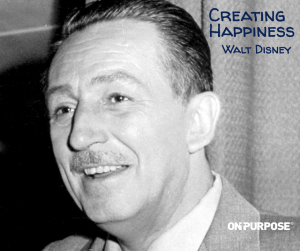
Most start-up businesses begin with great intentions but are at risk of being haphazardly led with little to no regard for the founder’s spiritWalt Disney Creating Happiness or original intent—even when the founder is still running the business! It is a costly loss of strategic advantage, employee and customer engagement, and business profits!
Some companies get it right and thrive. The Walt Disney Company’s 2-word purpose can be stated as Creating Happiness. They do a great job of living into that purpose.

Susceptibility

Most susceptible to this drifting from the founder’s spirit and intent are large organizations and institutions where work is highly fragmented across divisions and/or countries. Specialization must be paired with a sustainable corporate culture that honors and innovates upon the strengths of its past.

For example, did you know that universities and colleges such as Harvard, Yale, Princeton, and other Ivy League colleges were started as seminaries to train and equip ministers in the Christian faith? Today, these academic bastions of intellectualism and secularization are so far from their founders’ intent that their roots are obscured, if not outright ridiculed.

Candidly, most large businesses have lost a measure of their soul, and so they resort to conveying and communicating corporate values as the “fix” to the deeper loss of authenticity and congruency. When values need to be more codified and communicated than caught, then ethical business problems are predictably on the horizon.

Right behavior can be reinforced, but it can’t be legislated.

Hellegation™

Least susceptible to drift are micro-businesses or one-person entrepreneurs, freelancers, and such—provided they have clarified what matters most. Otherwise, they’re susceptible to the “chasing bright shiny objects syndrome.”

Solo owners face a different challenge, however. Founders of these SOHO (small office, home office) businesses are typically wearing far too many hats and are preoccupied with personally providing production, sales, and customer care. They’re easily caught in a vicious swirl of learning, working, and selling or overwhelmingly stuck in procrastination.

Fortunately, their passion to perform typically enables them to muscle through and deliver on a small scale basis. My term for this is Hellegation™—a condition where the solo owner has no one to delegate work to in order to be freed up to focus on more important matters to the health and well-being of the business, its customers, and society.

Years ago, I had a client who was starting an IT business. He got so lost in his software development, he soon forgot why he started a business. His intent was to help clients, employees, and his family, but he lost sight of the larger picture—becoming buried in the details. His strategic confusion produced a bewildering business design supported by a confused business infrastructure.

In my client’s case, lines of code were the means for creating value and making a contribution. He, however, got caught up in the making of money (financial profit) versus creating a profit for everyone (adding value). The true value of his business wasn’t code or cash but grounded in how his software improved the lives and productivity of his client companies and their customers.

By Design, On-Purpose

It sounds so basic, but the fundamentals of business really don’t change. Ultimately business is about people serving people. As today’s On-Purpose Business Minute encourages: do business by design. Clarity of purpose is your market advantage (or disadvantage if absent!). The difference from company to company is its business style, design, model, and infrastructure in alignment with its purpose, i.e. being on-purpose.

Any kind of plan or business plan for small businesses tends to be scarce. Who has the time to plan? or so the thinking goes. Understandably so because the plans are really not all that appropriate or useful in many businesses (see: What is the Purpose of a Business Plan?). Nonetheless, that doesn’t mean strategy and planning are useless and meaningless. They have a specific and powerful place in a company of any size.

(Special plug: A couple of years ago I met Jim Horan, creator of The One Page Business Plan. Here’s a great planning device for businesses of all sizes. It is, however, especially apropos for solo owners.) I also offer The Service Model as a similar but different way to analyze, build, and design your business. You can purchase instructions and a worksheet at The On-Purpose Shop.

Having a strategic context for building your business matters.

The On-Purpose Business Plan is a 9-minute video providing the essential steps to integrate the business design, plan, model, and infrastructure to reach and serve your customer base. This “map” of what’s needed is too often a missing perspective for those leading organizations. Admittedly, the agenda is full so connecting this many dots seems like busy work. In fact, it is vital business work to the development and growth of your team, culture, and business performance.

Regardless of whether you are an entrepreneur of a one-person show or the CEO of a billion-dollar business, as your business advisor and designer, you don’t call me until there’s a problem in the business that your team or you can’t fix yourselves. Your SWOT Analysis only takes you so far.

Stuck?

Let’s assume that you are competent at delivering your product or service, but the business isn’t growing. That means problems lie in the design of the business or the leadership or both! Conversations and conventional wisdom swirl around business infrastructure, business planning, and the business model, but it is like a fish swimming in water trying to see water—you won’t see it because you’re too close to the matter.

Times like this demand depth, not shallow manipulations of the status quo under the guise of change management. In the strategic depths of an organization, a slight adjustment in understanding, a tiny shift in strategy, or an orientation toward greater alignment ripple powerfully into positive results.

The simple articulation of a 2-word purpose statement is the tiniest of acts—but the most potent of all strategic initiatives.TOPBPerson cover

Tweaking the fundamental design of the business is not for the faint of heart. Eventually, failure to do so will be manifest in every facet of the business … and that’s costly at every line item on the budget. Strategic business design can elevate the business to the next level of performance, profits, and expression of its purpose.

———

The On-Purpose Business Person provides a solid framework for any person at work to learn how to be strategic and to approach their work as a business owner. Click here or on the image to the right to purchase it for $16. It is also available on Kindle for $9.97.

Get The Service Model worksheet here!

Do You Want A Balanced Life?

January 23, 2018 By kwmccarthy

Download A Balanced Life

Do you want balance in your life?

If you said “Yes!” then chances are you’re singing what I call the “Work-Life Balance Blues,” a sad song of addictive striving but never arriving.

In a previous blog post titled Striving for Balance, I shared my thoughts about this misguided yet pervasive notion that you can obtain balance your life.

It is hogwash and the sooner you come to understand this, the sooner you’ll be able to get on with your life.

In today’s On-Purpose Minute, I share “The Balanced Life,” a poem I wrote back in 2004. My hope is you’ll begin to see the folly in living the false ideal of a balanced life. At the top of this post, there is a link to download the poem.

Now, let’s touch on the alternative approach to living your life: integrating your life.

So just how does one integrate life? Integration needs a point of integration. Here is where knowing your 2-word personal purpose statement is essential. If you don’t know who you are, then any old you can show up anytime. A great place to start learning about your 2-word purpose statement is our newly launched online tool that helps you know your purpose. Visit ONPURPOSE.me for more information.

The absence of a unifying identity leaves us at risk of dis-integrating. Very simply, your life is either integrating or disintegrating—being pulled together or torn apart.

Beginning in the 1970s, people would talk about “getting my life together.” Implied in this fragmented existence is the longing to be whole and peaceful.

Balance is a devilish “ideal.” Balance pits two opposing forces against each other to create a fragile momentary emotional truce. Balance is marketed as being so sane and wholesome. Yet it is insanity and destructive.

Seeking balance avoids the deeper questions of life and leaves us thirsting to do more, earn more, and to “have it all.” Sadly, the risks of obtaining balance in one’s life produce just the opposite effect of the desired outcome. Instead, we’re running hard and fast, busy, burdened, always feeling behind, incomplete, and ragged mentally and physically. Unquenched, we press onward in a lost war of static attrition until finally we crash and burn out on the sidelines of life.

Integration is a divine gift, a workable progression rather than an unstable state of frenzied efforts. When you are approaching oneness of body, mind, and spirit, you’re moving toward a more productive and positive state of practical living. Your focus shifts from a fragile existence built on sandy soil to the solid bedrock of your inherent essence.

Integration demands a unifying core — a point that forms, informs, and transforms the realities of the world. This window on the world helps us to make sense of the senselessness and to find meaning in the otherwise absurd.

Purpose is your dynamic point of integration.

Integrate your life around your purpose so you can be on-purpose.

Cut yourself free from the balanced life mantra that kills your energy and spirit with a distracting illusion. You don’t want a balanced life because it can’t be had. Live your life integrated around your purpose, and you’ll inevitably be an on-purpose person in creation.

How To Get To Business Clarity

January 18, 2018 By kwmccarthy

We have just started a New Year. 2018 is rich with possibilities—so rich, in fact, it can be overwhelming.

My word for you for this coming year is this:

Depth through business clarity.

We’re all a bit ADD these days with the pace of life and the demands on us at work. It is easy to bounce from activity to activity. Playing in the shallow end of business typically produces meager results. You’re ready! Wade into the deep end of the pool.

Be more mindful in 2018 to keep your business simpler and more focused on what matters most.

Work on depth of

  • thinking
  • planning
  • relationships
  • business performance

Instead of being scattered across the plainsThe On-Purpose Business Person book cover of busyness, get focused on the gains in business that await when your team and you pursue excellence over expedience. Once you’ve positioned your business to be a leader, then you can focus on doing more of what you do best more profitably. Sounds like The On-Purpose Business Person to me. Re-read it this New Year.

Need some executive coaching or small business advisor services or consulting? We’re here to help! Email me.

Are You Full of “Should”?

January 16, 2018 By kwmccarthy

Stop “shoulding” on yourself and others.

Should is a powerfully debilitating word. It combines the spirit of good intention with a built-in disclaimer of failure. It is more potent than wishful thinking but far less honest. At least when we wish, we don’t really have the expectation of it coming true. Should—however directive and well intended—is deceptive and shame inducing.Should

Shoulds can be self-proclaimed.

Here are examples of typical shoulds:

  • “I should lose 20 pounds.”
  • “I should exercise more.”
  • “I should call my mother.”
  • “I should make that sales call.”
  • “I should save more money.”
  • “I should speak up for myself.”

These decrees of self-deception are mere words tossed off our tongues so we sound like we’re on top of a matter and knowledgeable … when, truthfully, we are not committed. Words without action amount to just a pile of sh… shoulds.

These “I should … ” statements are weasel words that neither inspire nor encourage.

Instead, we exile ourselves to be mired in mediocrity.

In the pairings below, which statement do you find more believable?

  • “I should lose 20 pounds.” Or “I will lose 20 pounds.”
  • “I should call my mother.” Or “I will call my mother.”
  • “I should get a better job.” Or “I am working to find a better job.”

The bottom line: Strike should from your vocabulary whether talking to yourself or someone else. People of strength don’t mince their words by shoulding on themselves or others.Detail_discoveryfree

P.S. As promised, here is the link to the free Discovery Guide preview. Use this preview version to gain clarity and direction for your life so you can say “yes” to what’s important to your life, career, and work.

Be On-Purpose!
Kevin

How Do I Focus My Small Business?

January 11, 2018 By kwmccarthy

How do I focus my small business?

This is one of the more common questions asked of me when I’m at speaking engagements or events. Candidly, it is a struggle I face as well. Opportunities abound for those of us with entrepreneurial instincts. But where do we plant our flag or make our stand?

For me, it was the idea of On-Purpose® well over 25 years ago. I can’t explain to you why this message came into my spirit and into my life. I didn’t ask for it. I didn’t seek it.

I expected to be a real estate mogul as a Florida-based commercial real estate developer. Through a bumpy series of twists and turns and near bankruptcy, I landed on On-Purpose. And I’ve stayed there with my focus.

Here’s my dirty little secret, however. There’s an old expression about niches that says, “You’re better off being an inch wide and a mile deep.” But what do you do when you are an inch wide, a mile deep, and then you go a mile wide again?

You see, being in and out of focus is risky at any depth. Some of the world’s largest brands will lose focus and go away. Ask shareholders from Polaroid, Enron, Bethlehem Steel, Pets.com, PanAm, DeLorean Motor Company, and Washington Mutual Bank.

Stuck Staring

I’ve been there sitting in my office staring at the walls or my computer monitor. My mind swirls with a hundred different items on my mental To Do List, but I watch another stupid YouTube video of bloopers, flash mobs, or pets or people doing funny stuff.

You’ve been there, too. You haven’t a clue what to do next because everything seems important.

Your brain is fried so you need a mental break. By default, you open up your email so at least you’re keeping up with something. A couple of hours pass at the keyboard and your true “To Do List” is only 50% longer, and a half of a day is now spent passing around pixels.

A sinking feeling leaves you even more overwhelmed and now adds personal disappointment with yourself. Ugh! How do I go about organizing the business? How do I get more focused and productive?

Admit it, you know this scenario all too well. I do! And it bugs you because it is sabotaging your business, your dreams, and your finances. With so much on the line, you wonder, How can I be so stuck? 

The Really Big Problem

Over the decades of working with business owners, this “Stuck Staring” pattern is most often associated with an ill-defined business—one being run ad hoc, in the absence of a plan.

While brilliant ideas abound in your brain, there’s no blueprint to build the business. Would you hire a home builder to construct your house who didn’t have blueprints? Yet, you’ll build your business without a blueprint.

There’s a reason most SOHO (small office, home office) or what I call Solo Owners don’t write their plans. It is rationalized as “the desire for flexibility and responsiveness to opportunity.” It’s BS. Unfortunately, keeping your options open typically results in a cycle of learning—but not one of earning.

The secret to building your business is to create an economically efficient engine of profit that is anchored deeply in your purpose and one for which you’re willing to pay the price. In other words, you’re passionate about it. Once the engine is up and running, you can afford to invest in your other ideas. Depth, not breadth, is essential. This takes discipline and commitment … to a well-designed, thoughtful, written plan.

Most small businesses don’t have written business plans or even powerpoint presentations. They would benefit from them. At On-Purpose Partners we offer a unique way to orient and organize your business around what matters the most—your purpose.

Learn more about the On-Purpose Business Plan. Using this link, invest the time to watch a 9-minute video about On-Purpose Business Plans and why they are different and helpful for solo owners to CEOs.

Candidly inquire of yourself, Just how is my plan working? If you’re not getting the results of speed to market, cash flow, and profits, then please consider a mentoring On-Purpose Executive Coaching program.

Better yet, come to Orlando and let’s invest the time needed designing your business so it is on-purpose. My team and I will bring order, focus, clarity, and direction to your business enterprise by guiding and codifying your business plan and model. Organizing the business is a couple of clicks and a few hours away. The ROI will be amazing!

  • « Go to Previous Page
  • Page 1
  • Interim pages omitted …
  • Page 13
  • Page 14
  • Page 15
  • Page 16
  • Page 17
  • Interim pages omitted …
  • Page 56
  • Go to Next Page »

Footer

Search this site.

  • Making Meaningful Money™
  • Leadership Mettle™
  • Booking Kevin
  • About Kevin
  • Endorsements

Copyright © 2026 · Kevin W. McCarthy, Winter Park, FL