• Skip to main content
  • Skip to footer

Kevin W. McCarthy

The Professor of On-Purpose

  • Book Kevin to Speak
    • Programs
    • Be On-Purpose®
    • Making Meaningful Money™
    • Leadership Mettle™
    • TOUGH SHIFT®
  • About Kevin
    • Endorsements
  • Blog
  • Search

Business

What Is Money Worth to You?

June 19, 2018 By kwmccarthy

What is money worth?

After watching and reading this On-Purpose Minute, I invite you to comment below.

Money, life, and work are interwoven life themes. Your money perspective paints your financial outlook. Here’s a preview:

Money matters!

There isn’t a day in your adult life when you’re not handling money.

Consider all we do with money:

  • exchanging money for time
  • making money on the job
  • spending money for groceries, goods, and services
  • doing money makeovers
  • investing money
  • counting money
  • worrying over money
  • saving money
  • wasting money

There are nefarious aspects of money such as counterfeiting money, stealing money, embezzling money, and “following the money.” The list could go on.

Money is everywhere. Money moves and measures the economy.

Money is our storehouse of value. Money is in our pockets and purses. Money rests on our dressers, in our drawers, and under our mattresses. When we’re short of money and long in the month, we’re worried.

Money can be the currency of a relationship, as in a couple fighting over money, investing for retirement, or saving for a home down payment. Money opens doors to social standing and status. There are people with old money and new money. Money can define a parent–teen relationship. There’s mad money. And then there’s money madness.

Money has meaning but it isn’t the source of meaning and worth.

It can be a source of security, income, worry, emotional stability or instability, the driver of our decisions, and generous giving.

Artists and theologians weigh in with gold nuggets of money advice:

1 Timothy 6:10 informs,

“For the love of money is a root of all kinds of evil. Some people, eager for money, have wandered from the faith and pierced themselves with many griefs.”

Did you catch that last phrase, “and pierced themselves with many griefs”? Talk about self-inflicted problems! Money is the result of service, provided there is a mechanism in place for a fair exchange of value.

Pink Floyd’s Money lyrics (first stanza below) from their album Dark Side of the Moon reflects the dilemma with the almighty dollar:
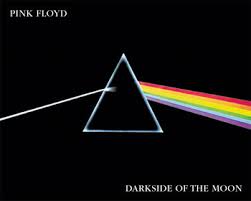
Pink Floyd Dark Side of The Moon album cover
Click the cover to order from amazon.

Money, get away
Get a good job with more pay and you’re O.K.
Money it’s a gas
Grab that cash with both hands and make a stash
New car, caviar, four star daydream,
Think I’ll buy me a football team
Money get back
I’m all right Jack keep your hands off my stack.
Money it’s a hit
Don’t give me that do goody good bullshit
I’m in the hi-fidelity first class traveling set
And I think I need a Lear jet
Money it’s a crime
Share it fairly but don’t take a slice of my pie
Money so they say
Is the root of all evil today
But if you ask for a rise it’s no surprise that they’re
giving none away

In a prior On-Purpose Minute titled, “How’s Your Trust Account?” I invite viewers to consider where their trust is located … really.

Previously, I asked you to consider what you would do differently with $100,000 in your pocket.

Money will become whatever you choose it to become.

Will you become a slave to it or will you be the master of it? Come to terms with your attitude toward money. Money can be a source of great confusion and consternation. It can also be a source for provision and blessing.

Money can help you be on-purpose! Every time you use it, ask yourself, “Am I spending or am I investing this money?” Then consider if you are spending time or investing your time.

Ask yourself this simple question: What is money to me? Now you’re invited to chip in below with your comment to the question: What is money?

Let me hear from you!

Be On-Purpose!
Kevin

P.S. Perhaps you remember this “Show me the money!” scene from the movie Jerry Maguire.
How Convincing Are You?

June 14, 2018 By kwmccarthy

When was the last time a salesperson convinced you to buy something? And how did that purchase work out for you?

Some salespeople see selling as a win–lose competitive game of point–counterpoint verbal combat. Be careful! It can work, but it is a highly skilled game that walks a fine line between providing the needed information and intimidating the buyer into a purchase—once!Sales is listening

Sales is learning what’s important to the customer and addressing it.

The best salespeople ask lots of questions; then they shut up and listen with both ears wide open.

For example, in technical sales where buyer and seller are highly qualified and knowledgeable, this approach can be an act of sizing up and iron sharpening iron. Generally, you’ll find that it is the buyer, not the seller, who initiates this more pressured approach.

Be careful, however, because the difference between healthy banter and an unhealthy, dominating buyer may be a very thin line. In the latter case, a humble, noncombative approach may serve you best. In other times, the better the banter, the better your chances. Skilled salespersons can turn it on or off depending upon the buyer’s style and by assessing the appropriateness of the situation and person.

In a sales situation where the seller knows more than the buyer and the buyer is communicating the need for input or insight, attempts by the seller to convince the buyer often result in a buyer turnoff. The buyer may sense that the seller is more interested in making the sale than consulting or serving them with integrity. In short, they don’t trust the salesperson. When that happens the transaction is disadvantaged.

One of the great challenges in selling today is the leveling effect of information from the internet. Most buyers can find tons of information, reviews, and competitive analysis on goods and services. Therefore, as a salesperson or business owner who is selling, counting on your strategic advantage as being more informed than the buyer is a dangerous proposition. In fact, you may be more knowledgeable and experienced than the buyer, but to try to argue or convince the buyer sets up a high-risk scenario for creating distrust. Humility, not hubris, is the better path.

One of your strategic advantages and value propositions is the diversity of clients and customers you’ve worked with. In other words, you see patterns of use and abuse. You’re able to borrow from the experience of other customers and advise clients as to likely scenarios they may encounter and may not have anticipated.

Those involved in selling often find themselves in a really tough place.

From the strength of their knowledge and conviction, they perceive they know exactly what their client or customer needs, yet the client isn’t buying. Your natural inclination may be to lean into the act of convincing them with an even more reasoned set of facts, benefits, and features why this is the right purchase for them. Just how convincing do you think you’ll really be?

When that urge to tell overtakes your tongue consider just the opposite approach. Ask more questions. Ideally, you have what I call a “patterned conversation” in which you have a strong sense of what needs to happen (a pattern of questions that leads to an informative and insightful exchange) but not a preconceived notion of where it may lead.

Ultimately, buyers are looking to advance their larger goal.

If you don’t know the larger goal then you’re not really listening and learning what’s at stake.

Getting into a “convincing-fest” is rarely your best approach for earning the relationship and sale. It is often an indication of a salesperson who is taking shortcuts or is using dominance or personality or style to pressure someone into doing something they don’t want. This manipulation, however, can work.

Alternatively, there’s a time when a customer needs to be led to their decision. Leveraging your experience and capacity to anticipate their needs, you’ll take them along the path of discovery versus jumping to the final destination. It takes more time, but it often makes for a better solution for the client because you, too, will learn some things along the way and be able to provide a more valuable end result. Truth be told, you can make a sale or you can build a relationship. Ideally, you do both.

Why Does Change Management Fail?

June 7, 2018 By kwmccarthy


What is change management’s greatest failure?

I am a contrarian about change management. It is just plain sloppy, imprecise language by the manager to describe a process and not an end result. The strategic work and a meaningful communication and action plan are missing. In the end change management invariably whips the corporate culture into a phase of unneeded confusion resulting in lost productivity and broken momentum.

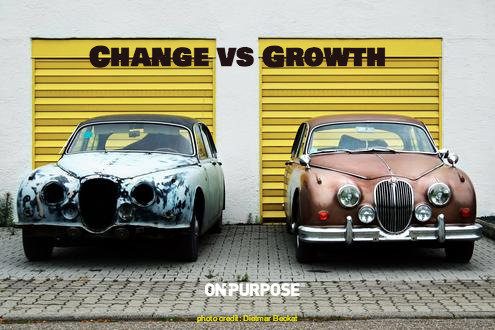
There is a better way—growth management!Rusted Cars

Change management is too often the latest in a line of misguided management marketing ploys to justify their efforts and position themselves to employees and shareholders as being on top of the business when they’re not. The employees know better and the shareholders are too distant to recognize the deficit of details being sold to them as strategy and leadership.

Change management is used at every level in organizations where two or more persons form a team. Supervisors to CEOs use the word “change” as a subtle form of control. Change management is a “wonderfully” accepted and euphemistic term in the general management business community for “a bunch of people (but not me) are going to pay a price for what’s getting ready to happen in this company.” Change managers use a variety of terms to disguise the stark reality that they are imposing their will upon their team and the consequences will fall upon the team.

Per Wikipedia, the definition of change management is “… any approach to transitioning individuals using methods intended to redirect the use of resources, business process, budget allocations, or other modes of operation that significantly reshape a company or organization.”

True translation:

Change = everyone else is going to accommodate what the change agent is saying and that person is just trying to figure out a way to break the bad news to you but doesn’t have the guts to speak plainly.

Amazingly, change management is the name of courses in business schools with professors and degrees focused on it. Major consulting firms have entire practice areas focused on it. Yet it remains a misdirection and distraction to the health and well-being of organizations.

As a business person or business leader, change is a word that you need to take as a warning to your own management approach. When you talk about change, it means the leader is either unclear about his or her vision or is unwilling to state it clearly. The subjects of the change, who are often far too trusting or at risk of challenging, will eventually learn whether the change was for good or for bad.

Regardless of the venue, leaders who market “change management” are as laughable as the emperor’s new wardrobe. The “beauty” of change is that it offers no measurable result, direction, or accountability.

Change can be negative or positive.

It just means something will be different, period. Well, of course, something will be different. Don’t settle with change—clarify what it means and where it is leading. Know the direction. Understand the destination.

Change is blind strategy with an escape clause for the change agent but rarely for the recipients of change. In reality, expect decline unless luck prevails!

The Power Option: Growth Management

Change is risky business. Few of us like change. Yet change, like breathing, is a fact of life.

Instead of change, let’s make the standard one of growth management.

Now the business person (or CEO) is focused in an upward direction and has a measurable result with a charge to add value instead of an ill-defined, open-ended nothing strategy that’s likely to result in decay rather than in growth. Decay is easy—do nothing. Growth, however, requires rolling up one’s sleeves, yanking out the weeds, and nourishing what’s discerned and defined as desirable.

Growth can include profits, behavior, people, relationships, and morale. Change is ultimately unaccountable babble left to the discretion of the leader making the change and an empty vision. It may sound inspiring, but it is merely sleight of hand illusion.

Growth requires a proactive partnership of time, money, talent, and a host of other factors coming together to a common cause. Growth is still a broad term that, like beauty, is in the eye of the beholder. It does, however, call forth cooperation, effort, and something of a more positive and productive nature on the personal, professional, and organizational levels.

Here’s a simple example. Pretend your boss walks in and says, “Let’s talk about a change I’m making to your paycheck.” What’s your response? You’re sure a pay cut is coming. You anticipate that your job or territory is getting ready to be reduced or eliminated. Am I right?

Now let’s imagine your boss walks in this time and says, “Let’s talk about a growth I’m making to your paycheck.” Growth has replaced change. Now assuming your pay stub doesn’t have a tumor, in the second example, you’re getting engaged and excited because your boss is communicating that plans are in process for a raise and an explanation for your coming reward. Economic growth and development trump economic change (and decay).

The mere act of replacing one word makes all the difference. Change is an implied downer. Growth is an exciter.

My suggestion: only use the word change when describing what’s in your pocket after buying your Chick-fil-a lunch any day of the week except Sunday. Change is apropos when reporting on the past. It is not a strategy for the future. Be in the business of growth and you will more likely be on-purpose.

Learn more about how to strategically and effectively create a pathway for growth management and value creation. Watch The On-Purpose Business Plan 9-minute instructional video.

Why Do You Work?

May 31, 2018 By kwmccarthy

How many times do you say, “I’m off to work”?

Does saying that conjure up light bulb with quotation "Are you being and becoming, or just selling out?"emotions of joy and excitement, or do your teeth clench and does your stomach churn and turn?

Your answer to this question goes to the heart of your life, health, and well-being in your spirit.

  • Are you one of the fortunate people who loves their work and has skillfully integrated (not “achieved” a work–life balance) the lines between work and life?
  • Have you become so fully integrated that you are on-purpose in business and in life? Are you compromising or being conditioned for your next great assignment?
  • Are you selling your soul or sailing along on-purpose?

Lots of questions for you to ponder.

Does thinking about this sound like work to you?

Sooner or later you will either answer the questions or pay the price for not answering them.

Got a comment to make? Go for it below. Let me hear from you.

Be On-Purpose!
Kevin

What Would You Do With $100,000 In Your Pocket?

May 24, 2018 By kwmccarthy

Lessons learned in business can often help us in life.

Here’s a true story of one of the several times I’ve been taken advantage of in business and lived to tell about it. Someday, perhaps, I’ll tell you more war stories.

For now, this On-Purpose Business Minute speaks for itself. It is longer than normal at 6 minutes, but it is a story that needs to be understood because it is rich in many lessons.

After watching this, here are some questions to ponder by yourself, with your family, or among your team:

  • Are money and confidence related? If so, how and why?
  • What are the limits to your service and compromise to keep it from becoming abuse and disrespect?
  • What can you do to avoid putting yourself at risk of being dangled by dollars?
  • If you had $100,000 extra in your pocket, what would you be doing differently from what you’re doing today?

Please share your thoughts, experiences, and insights in the Comments section below.

What Is Your Cost of Pride?

May 10, 2018 By kwmccarthy

We businesspersons tend to be an independent breed.

We take pride in our work ethic, standards for excellence, and accomplishments. This is often what it takes to start a business, to persevere in the challenges, and then thrive.

There’s often (not always) a downside to this self-reliant trait.

This On-Purpose Business Minute invites you to consider the cost of pride especially in light of the subtitle to The On-Purpose Business Person: Do More Of What You Do Best More Profitably.

How do you know if your pride is costing you?

After watching today’s On-Purpose Business Minute, invest 159 more seconds to assess yourself with the following 10 questions:

Here are the 10 questions about pride:

  1. Do you describe yourself as a helper?
  2. Are you a low-maintenance friend or employee?
  3. Are you apt to say, “It’s just as fast to do it myself“?
  4. Do you believe “If I want something done right, I have to do it myself”?
  5. Are you one who hates to burden other people with your problems?
  6. Are you the person most people turn to for advice, wisdom, and counsel?
  7. Do you find yourself being more and more burned out and then bitter towards others?
  8. Are you easily frustrated that others can’t do what you do as fast or as well?
  9. Do you say, “I can’t afford to hire the expertise I need, so I have to learn how to do it myself”?
  10. Do you say, “I know what I need to do. I just haven’t gotten around to it yet”?

The more questions you answered with a “yes,” the more likely it is that your self-reliance is costing you more than you imagine. You are pushing people away from helping you and shouldering too much of the burden yourself.

Determine your cost of pride.

It could include job loss, slow business growth, long hours, stress, high turnover, ill health, strained relationships, being passed over for a job/raise or a hundred other costs. Do a quick assessment of your cost of pride. You may be stunned.

Share your assessment with a trusted advisor or friend. Invite them to identify what you’ve missed or where you are blind. Ask them for their opinion, be quiet, and avoid being defensive.

The simplest and most comprehensive action to take is to adopt and live into the On-Purpose Approach of Doing More of What You Do Best More Profitably.

Keep this adage in the forefront of your mind. You will prosper!

How Much Planning Is Enough?

April 26, 2018 By kwmccarthy

“How much planning is enough?” is a question I’m often asked by business clients. It poses an interesting query because some of us are planners and others of us are more action-oriented.

There is a fine line between “gettin’ ready” and “gettin’ going.”

None of us are immune from the dilemma of how much is enough.

I see this in my business and life, and, even, authoring books and articles or producing On-Purpose Business Minutes.

Here’s one of my On-Purpose Proverbs on the topic. Perhaps it will give you a rough rule of thumb:

People who don’t have time to plan, need to plan more. People who have time to plan, need to execute more.

Figure out which one “people” you are and adjust accordingly!Image of businessman. "Planning? People who don't have time to plan, need to plan more. People who have time to plan, need to execute more."

Here’s a bit of a litmus test for you to see if you’ve got it right.

If your business is making sufficient revenue AND you have a high degree of personal and professional satisfaction PLUS you’re optimistic about the future, then chances are you’ve struck the right chord. If, however, the previous sentence doesn’t describe your current reality, then use The On-Purpose Proverb above to make a quick assessment of where you need to adjust your attention to find improvement.

Planning is typically considered to be in the wheelhouse of strengths for executive officers.

The reality is we all need to be planners to some degree. The difference in planning from the boardroom compared to the mail room is the scope and authority of the influence. The greater the authority and number of people following the plan, the more important the role of planning becomes to the organization.

Oh! One last thing. When doing planning, please make sure you execute on at least one thing: create a written plan, even if your plan is as simple as a “to do list” with names and dates. The “I Got It Right Here Between My Ears Plan” is really a dream without a deadline, details, and typically, satisfying results. You’re too at-risk of being distracted by shining new objects that cross your path.

“The executive of the future will be rated by his ability to anticipate his problems rather than to meet them as they come.” — Howard Coonley


Admit it! You’re prone to unproductive distractions, but chances are if you’re a person who invests time to watch the On-Purpose Business Minutes, then you’re committed to working on you, to becoming a better person and leader. What tips or suggestions can you offer us? Please use the comment section below to share your wisdom and school of hard knocks lessons learned.

How Are You Learning to Be in Business?

April 19, 2018 By kwmccarthy

Most people in business really don’t know what they are doing when it comes to the business of business.

It doesn’t mean they aren’t successful. It means they generally aren’t as successful as they could be. In a moment of candor, most of us will tell you that we’re plowing into virgin territory regularly. And what we’re doing for continuing education is generally a hodgepodge from a variety of sources.

A great solution is to join a peer learning group. More on those later in this post.

If you own a business and you don’t understand the foundations of business, then you’re likely functioning at 50% or less of your potential. Where else can you get an ROI (return on investment) like that for such little effort and energy expended?

Learn to be a Business Person

Most management and business training tend to be job specific or skills related. Overlooked are the fundamental concepts of business, the free enterprise system, and basics of what is called “general management” and business leadership. It is expensive to learn the basics of business.

Most businesses are built by—as Michael Gerber, author of The E-Myth Revisited: Why Most Small Businesses Don’t Work and What to Do About It, calls them—technicians who have an entrepreneurial seizure. They haven’t got a clue about being in business. Look no further than the professions of engineering, medicine, and law, for example, for really smart people who often don’t have a clue how to do business but are in business or own one. At least the professions have enough honesty to call them practices instead of businesses. : )
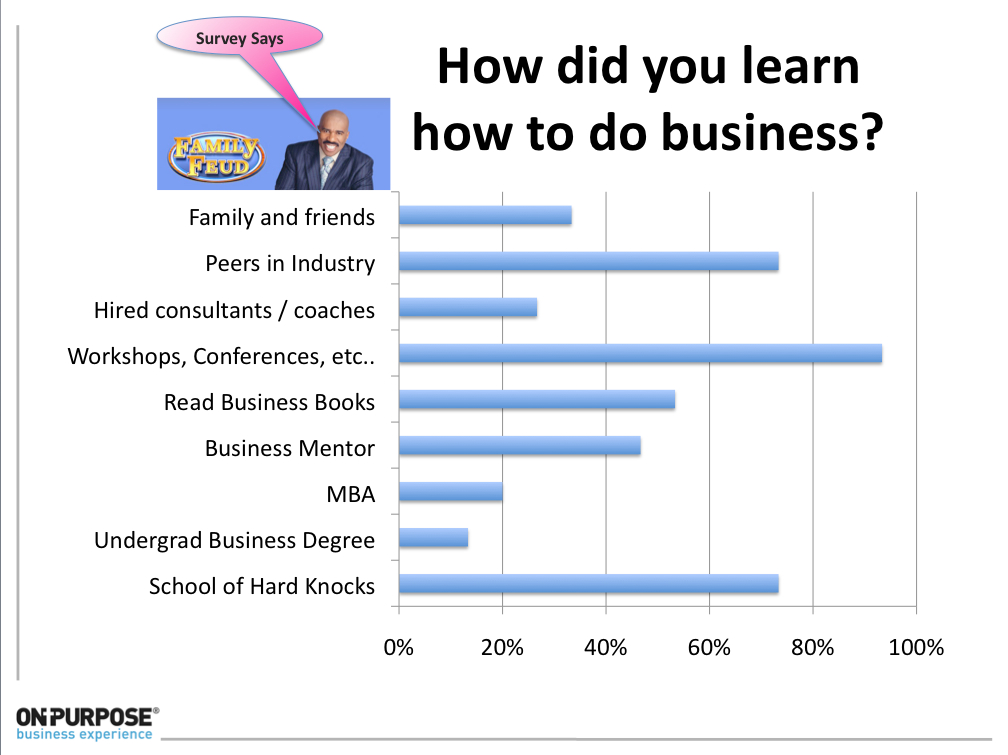
For years I’ve asked the question, “How did you learn how to do business?” The typical response is “School of Hard Knocks.” In other words, trial and error is the teacher—a cruel one at that. Check out the results of this small study I conducted with attendees of a previous webinar. (click on it to see a full-size version)

How Did You Learn to Do Business A small percentage of people have undergraduate business degrees or an MBA.

Candidly, as a man with both an undergraduate business degree (BS from Lehigh University) and an MBA (University of Virginia Darden Graduate School of Business Administration), I’ll confess my college degrees prepared me with concepts, tools, language, and business context. They didn’t, however, turn me into a businessman. Degrees accelerate learning but they don’t make the person quite like being on the job does. We can’t avoid the School of Hard Knocks, but we can be prepared to learn the lessons faster, smarter, and less hard.

Becoming a Better Business Person

What are some of the ways to improve as a business person?

  1. Business consultants are an effective means for business improvement. Match a consultant’s strengths to your weaknesses and your business will prosper. Use consultants to set-up, fix, and refine systems where you lack the expertise or time to learn. This is especially helpful for those one-time set-ups such as an accounting system, putting up a website, or succession planning.
  2. Executive and business coaching are ways to improve as a business person on the job. Having someone come alongside and “teach you to fish” is important.
  3. Peer business owners outside and inside your industry. Generally, these are casual meetings where you learn from one another. Golf is often played!
  4. Associations often provide industry-specific training and resources. Tap into your association and see what they have to offer. Another great source is your Chamber of Commerce or local business development center. They often provide very reasonably priced training with local experts.
  5. Read books on business and leadership: Shameless plOP Book covers stretchedug coming … Read The On-Purpose Business Person and The On-Purpose Person. Together they lay the groundwork for leading a business and leading your life.
  6. Peer Learning to the rescue: One of the most overlooked programs for business training is non-competitive, facilitated, peer learning groups. In Napoleon Hill’s classic book Think and Grow Rich, he introduces the business idea of mastermind groups. These are generally self-managed versus having third-party facilitators who prepare the agenda and lead the group. Peer learning groups are also called business roundtables or CEO groups. The power of having peer learning grows your learning exponentially because the groups typically involve business training, reading business books, special learning programs, or technologies. In other words, they combine all the ways we learn plus the many benefits I’ve outlined in this On-Purpose Business Minute.

Here are some recommended resources for peer learning groups:

  • CEO: Colleagues of Executive Online: John Smith, the founder of CEO, pioneered the concepts of business roundtables for Christians in 1989. In April of 1990, I joined one of John’s CEO groups. He’s been a mentor and friend ever since. John now offers virtual groups leveraging video conferencing. I’m a co-chair of a group with John.
  • Vistage International: I know several people who participate in, speak to, or chair Vistage groups. Generally, Vistage members are running businesses with a minimum of ten or more employees. Dave Zerfoss in Charlotte, NC, is a personal friend and top-notch chair. Connect with him directly if this interests you.
  • C12: I know Buck Jacobs, the founder of C12, as well as many members and chairs. C12 is designed for the Christian business person. In Orlando, connect with Kevin Respress.
  • Peerspectives Roundtables: Peerspectives is both a group as well as a specific technique developed by the Edward Lowe Foundation. The Peerspectives technique provides a structured approach to problem-solving and sharing. A friend of mine, Steve Quello, uses this approach in Florida.
  • Christian Roundtable Groups are sponsored by Truth@Work and are designed for solo owner or SOHO operators.
  • The Advisory Board has been around for decades. I don’t have personal experience or relationships there but given its long-standing presence, I have to believe they offer excellent value and opportunity to grow.

So there’s my short list of recommendations for bolstering your business skills, concepts, and relationships. If you are serious about growing your business to the next level, then run, don’t walk to find yourself a peer learning group.

  • « Go to Previous Page
  • Page 1
  • Page 2
  • Page 3
  • Page 4
  • Page 5
  • Page 6
  • Interim pages omitted …
  • Page 16
  • Go to Next Page »

Footer

Search this site.

  • Making Meaningful Money™
  • Leadership Mettle™
  • Booking Kevin
  • About Kevin
  • Endorsements

Copyright © 2026 · Kevin W. McCarthy, Winter Park, FL