• Skip to main content
  • Skip to footer

Kevin W. McCarthy

The Professor of On-Purpose

  • Book Kevin to Speak
    • Programs
    • Be On-Purpose®
    • Making Meaningful Money™
    • Leadership Mettle™
    • TOUGH SHIFT®
  • About Kevin
    • Endorsements
  • Blog
  • Search

Business

Facing A Decision? Got A Decision Making Process?

February 22, 2016 By kwmccarthy

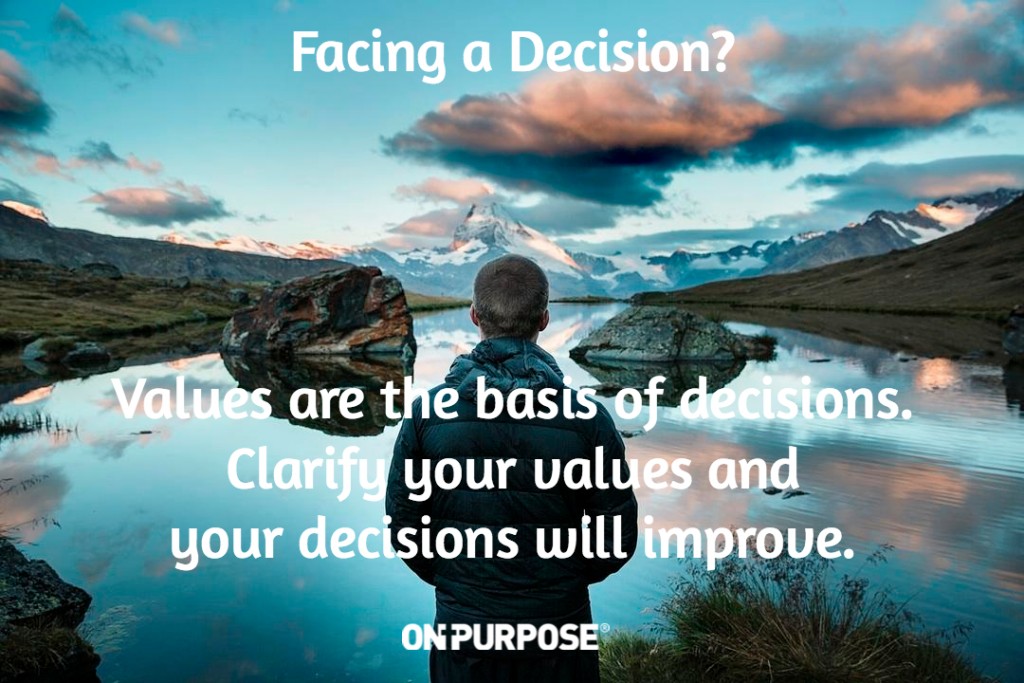
Facing a DecisionAs a person or an organization matures, decisions need to be distributed across the team to those closest to the choice. In the absence of clearly articulated and communicated values (and a 2-word purpose) even the most well-intended person makes ungoverned decisions — typically on emotion rather than values.
Where is the root responsibility for such “ungoverned decisions?” If values are not “articulated and communicated” plus reinforced regularly, then leadership, not the person, has failed.

Consider the sheer number and importance of decisions made every day by every person associated with your organization. Every line item on your income statement reflects a decision. Ask: Do we have a specific decision making process in place that is introduced at orientation and is a regular part of our corporate conversation and storytelling?

The highly likely answer is, “No. In fact, with everything else I need to get done, this hasn’t even been on my radar.” The problem is you’re too busy making decisions that could be better done by someone who is closer to the problem who is trained, tested, and trusted.

Experience tells us that this leadership “oversight” undermines sales and profits by 25% annually. Run the numbers — now you know the price of poor leadership!

Better Decisions = Better Business

Values seem well below the surface of the daily waves of activity. In fact they are on the surface of every decision made by every team member. Coming to terms with this hard reality in the busyness of the day can be a daunting, humbling, task for the leader.

On-Purpose Partners helps clients to define, share, and activate their purpose, vision, mission, and values (PVMV) so better decisions are more consistently made across the company.

Follow our 3-step ACE decision making process to align and improve the decision making quality, speed, and effectiveness:

  1. Articulate: Purpose, Vision, Mission, and Values (PVMV). These “On-Purpose Statements” can typically be identified, refined, and written in less than a week for most organizations. For smaller businesses they can be completed in less than a day.
  2. Communicate: Find authentic stories within the organization that reflect the values. Create an open dialogue to introduce them to the larger team so ownership of them spreads into the hearts, minds, and guts of those who engage.
  3. Exercise: Put your On-Purpose Statements to work by creating decision matrices across the organization. Here are just a few places decision-making is improved using On-Purpose Statements:
    1. Strategy & Planning – It is easy to get mechanical and analytical about strategy and planning but your PVMV keep it real on a human level.
    2. People – Employment, engagement, and retention of team members are profoundly influenced by PVMV. This is where “The Tingle Factor” comes from. See The On-Purpose Business Person to learn more about The Tingle Factor.
    3. Financial management – Complement the ROI, NPV, or IRR analysis with your PVMV analysis.
    4. Vendor/sub-contractor selection – Does the vendor demonstrate similar PVMV? Have you shared what you value as a part of right business performance?
    5. Operations – Are the people and processes informed and aligned with the PVMV to create the performance needed to grow the business? If not, then you’re producing a flawed product.
    6. Marketing & Branding – Truth in advertising matters. What, however, determines “truth”? Your PVMV keep the company true to what matters most.

The power of On-Purpose® is profoundly relevant to execution and profitability — but only when the CEO or leader decides it is. Otherwise, it is business as usual.

Business as usual or business on-purpose? Now you’re facing a decision!

How Convincing Are You?

January 26, 2016 By kwmccarthy

We’ve become a contentious and polarizing culture. What place is there for hard edges and righteous attitudes in the course of civil conversation?

Does convincing work? No!

Is it more important to be right or to be in a right relationship? This doesn’t mean that you become a doormat for others to wipe their waste on your thinking or person. Rather it means that you maintain your dignity and decorum as others debate and argue. You need not be defensive or offensive, simply be an adult who doesn’t get drawn into the fray unnecessarily.
Conversing

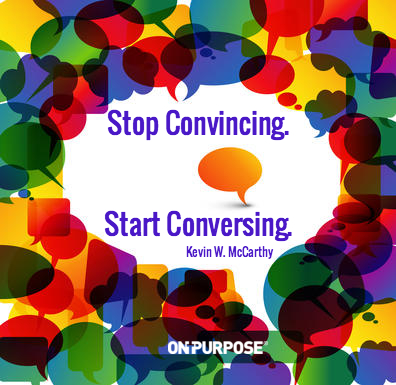
To influence another person’s thinking there must be a basis of some trust and respect, period.  Those qualities of leadership only come within the context of relationship where conversation, not convincing takes place. Stop convincing. Start conversing!

This approach is much easier said than done. A great technique is to say to someone, “Look, I know I’ll never convince you to change your position, nor you mine; but I would appreciate understanding your rationale, perspective, and opinions on the matter.” Then sit back, ask questions, and learn what the other person is thinking. Then sincerely thank them for sharing and walk away better informed and prepared to understand a different point of view. Build the relationship!


How to Make Money?

January 14, 2016 By kwmccarthy

Regardless of whether you have a job or own a business, today’s On-Purpose Business Minute invites you to explore three aspects of what it takes to make money and make even more money. 

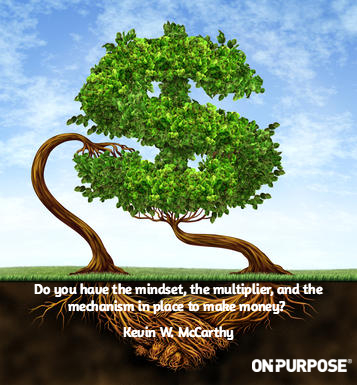
Make Money TreeDo you have the mindset, the multiplier and the mechanism in place to make money?

For most people, how much money they want to make isn’t the challenge … it is making that amount of money that presents the real issue. So let’s revisit this classic On-Purpose Business Minute and explore some simple elements to making money.

Study the people who made or make big money — Sam Walton, Warren Buffet, Donald Trump, Bill Gates, Stephen Jobs, or whomever comes to mind — and you’ll find the three essential M’s are present and to the creation of their wealth in a socially responsible manner and in a way that is meaningful to each person.

—————————

Do you have a favorite quote about money and wealth? Share it in the comments section. Here are some that I found valuable.

Abundance consists not alone in material possessions, but in an uncovetous spirit.

                Charles M. Sheldon


Those who condemn wealth are those who have none and see no chance of getting any.

                William Penn Patrick


That some should be rich, shows that others may become rich; and is hence just encouragement to industry and enterprise.

                Abraham Lincoln


Click here to receive an email when I post new On-Purpose Business Minutes.


What Do You Do Best?

December 31, 2015 By kwmccarthy

As A New Year Rolls Around: What Will You Do Best in 2016?

The On-Purpose Business Person
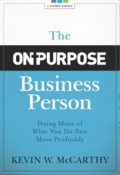
Here’s the new cover to The On-Purpose Business Person since this classic OP Business Minute was recorded

This simple, yet highly clarifying question from this Classic On-Purpose Business Minute carries strategic value and importance to every aspect of your business and life. Your answer matters. Don’t get hung up on the perfect answer. Have a written answer that is in the ballpark. That alone will powerfully direct and clarify many decisions you face today and will face in the New Year.

The subtitle to The On-Purpose Business Person provides an important strategic statement that is so simple that one might miss the power and potential to transform your career and/or business. 

Consider the centerpiece of the subtitle: Doing More Of What You Do Best More Profitably. It can transform your life, career, and business.

Have you read The On-Purpose Business Person? You’ll learn how to do more of what you do best more profitably.


Why Do I Need to Align & Integrate My Business?

December 10, 2015 By kwmccarthy

Within our business advisory firm, the single greatest “request” we get is about sales growth or income generation. There are lots of quick-fix remedies to tweak sales. There are marketing strategies, too, that can position the business for improved selling opportunities. Business strategy examples can only take you so far. Be specific. Worse, you’re selling your business short of specificity when you copy what others do. Your business is unique, so the business strategy and model need to capture that.

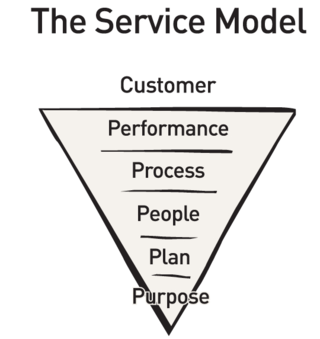
What you need is a universal tool to address your unique needs — that’s The Service Model (below). Here you have both a tool to create and build business strategy as well as analyze and improve what exists. Regardless of whether you are the CEO of a major corporation or a commissioned salesperson with a territory, you have a Service Model by either default or by design.

At On-Purpose Partners we help our clients assess the underlying strategies, structures, and systems — the foundations of an organization found at the bottom of the Service Model (Purpose and Plan). Slight misdirection here only gets amplified throughout every line item on the P&L and the corporate culture through the People, Processes, and Performance.

Service Model 1-page worksheet & instructions

Most clients call because they have a “Performance” level problem — such as not enough revenue. So they’ll do the quick fixes to performance or dig a bit deeper into the Process area (Marketing). Or, they’ll gin up the sales team with incentives to meet current objectives at the risk of sustaining the relationship.

In other words, they start where the problem appears and try to fix it there. There’s merit to this, but if there are persistent problems, then this doesn’t address the root cause. In fact, it tends to create a frenzy of latest gimmicks. It becomes almost addicting activity.

Addressing Process matters such as Marketing or Training looks at systems for solutions. This is a smart move because if the system has flaws then the Performance will suffer. I’ll venture a guess that 98% of most consulting work is hired in the Process and Performance level.

The challenge, however, is that the Purpose, Plan, and People levels are too often neglected or assumed to be properly working. Here’s why. The responsibility for these levels falls to the leadership and management of the organization. It is hard to self-assess. Much like a fish doesn’t realize it is swimming in water until it is out of the water, leaders and managers rarely have the perspective to see their own context.

What To Do:

Define your Target Audience (Customer). Then, remodel your business by starting at the bottom of the Service Model and work your way to the top one level at a time.

Call it business alignment or getting everyone pointed in the same direction; the bottom line business objective is sales growth and profits. When the people and business strategy are confused on the inside, the customer or client experience is diminished. Losses mount in profits and people. It can get ugly!

Here’s how to create a better result for your organization. Know that alignment works but it stops short. Start with your goal or a vision, pare to the core, create alignment, and continue working on the business and with your team until all are more fully integrated.

Step 1: Setting the goal or writing the vision is typically the easy part. It may take time and some thinking and noodling with your brain to clarify it in writing, but get it done in writing.

Step 2: Alignment comes in many forms. Here are a few:

  • The On-Purpose Principle: This is the purpose of the person aligned with the purpose of the organization. If this alignment doesn’t exist, then everything else is manipulation or feels like manipulation. Work must be a meaningful expression of one’s life.
  • Strategic alignment within the business means, for example, that the business strategy informs the marketing strategy which informs the sales strategy and provides for tactical direction. Social media in particular needs to align or it is just a waste of time. Use the Service Model to guide you.
  • Customer alignment means the business is highly designed, built, and oriented to serve the customer while uplifting the team.
  • Project alignment means that the team players seek a common outcome or objective.

Alignment is an important and solid step but it falls short of what is needed. Business process engineering or re-engineering efforts are directed toward business alignment. When a business is missing its core strategy then there is no cornerstone for aligning and building.

As a business advisor, I consistently see money poured into tactical execution (Performance) when the strategy is deeply flawed. The waste of money and effort is monumental. Worse, I see good money chasing bad business designs time and again.

Websites provide a great example. So you’ve finally gotten your website launched and you’re waiting for the visitors to start finding you thanks to your investment in SEO (Search Engine Optimization and Google AdWords). It isn’t happening, so you invest even more money in your SEO and AdWords campaign. But what if the website, itself, isn’t welcoming or fails to present a call to action? Much of the investment in SEO and advertising dollars is wasted or hopelessly inefficient.

“Getting the business aligned” is often heralded as the cure for what ails the business. It is important, but it stops far short of what is really needed.

Step 3: Now that the goal is set and the strategy and structure are in place, turn to the relationships. Does your team understand the purpose of your organization? Have you clarified and communicated the purpose? Do they have a sense of call and contribution that allows them to get beyond the inevitable personality and preferential differences? Do they see their individual and collective contribution as so important that they can work as a team toward the greater good?

The higher level concept is integration. Strategically, purpose is the point of integration. Alignment deals with tangibles and direction. Integration deals with the people plus the intangibles and tangibles to create a wholeness to the organization. It provides a fabric to the culture and brand of the business that translates to the customer experience being extraordinary.

Work on alignment, yet remember to go the next step to create integration of the business beginning with the purpose, plan, people, process, and performance. Integration gets you to the gestalt of business where it works effectively and efficiently.

Do you need some one-on-one work on your business? Do you want me to help you create the path to being on-purpose? Contact the office to arrange an advisory relationship. Small Business Advisory Packages are available for one-on-one help with me (Kevin). Need more information? Call: 407.657.6000 or email us at info@on-purpose.com.

Is a Startup Business a Smart Career Move?

December 3, 2015 By kwmccarthy

Are you unemployed, underemployed, or just plain finding that your corporate job is slowly sucking the life out of you? Are you gasping with this suffocating sense of being stuck with just enough air to breathe, yet barely enough to thrive? Is some combination of your income, lifestyle, family relationships, and health suffering because of dissatisfaction and frustration with your present work situation?

Start Small. Keep Your Overhead Low. Work Hard. Pray Unceasingly.

Starting a business isn’t just for people with business degrees and experience. Motivation, hard work, and a willingness to learn serve any budding entrepreneur.

Plan ahead for starting your business off right. In time, you’ll ease into the transition. Sometimes it is thrust upon us from necessity. Regardless of whether it is a retirement, layoff, job elimination, or simply what you want to do, starting a business is a smart move.

Here’s my list of 10 compelling reasons for starting a business:

  1. Escape the rat race. Get out of that corporate job and transition to more meaningful and enjoyable work.
  2. Personal expression. A business can be a creative outlet for a hobby or passion.
  3. Independence. Set your own hours, decide who you want to target as your customers, and don’t have a boss.
  4. Retiring to work. Retirement looms in a few years so growing a business represents a smooth transition and new sense of work identity.
  5. I need the income. Your small business may provide extra income to cover the bills for braces, college, and vacations. As it grows it can replace your current salary and become full time.
  6. Tax breaks. A small business is a vehicle for deducting some existing expenses from your tax return. Consult your CPA, but when the business picks up a fair share of the bills, it can ease the household budget.
  7. Ambition. A small business can become a big business! Put your ambition to work.
  8. Change the world. A business can be the means for you to truly change the world with your business idea, invention, or service.
  9. Plan B Security. A sour economy can be a ripe time to start a business. In such times it may be the means to provide for one’s family and self in the event of a job loss or cutback. Security matters.
  10. I can do better. Many businesses have begun because the founders knew they could do better than their employers or what was offered on the market. I’ve seen women-owned businesses blossom simply because the founder wanted equal pay in parity with men and to do better for her family.

Do you need to be the next Elon Musk of PayPal, Jeff Bezos of Amazon, Steve Jobs of Apple, or Bill Gates of Microsoft?

Not really … but what if you could be? Are you ready to trust your dream? Starting a business may be one of your smartest moves yet.

Be On-Purpose!

Kevin

Protected: Recommended Business Reading: Our Unfair Advantage

September 25, 2015 By kwmccarthy

This content is password-protected. To view it, please enter the password below.

Are You Setting Goals?

September 3, 2015 By kwmccarthy

This is a classic On-Purpose Minute that first aired in August 2010 so the September offer regarding The On-Purpose Leader Experience is out of date. Alternatively, consider reading The On-Purpose Person and downloading the free preview to The Discovery Guide.

Another option is On-Purpose Peace, a six-session, small group study for Christians reading The On-Purpose Person. 


Goal setting is really the poor man’s way of doing strategic planning. Guess what? For about 95% of what you want to accomplish, writing out your goals will get the job done. If you want to take something to the next level, however, you’ll need to invest in strategic thought and planning. Otherwise, you’ll remain mired in mediocrity.

Research shows that as few as 1% to as many as 10% of all people write down their goals. Why not more people? Here are some of the excuses I’ve come up with. What’s your reason for not setting goals?

  1. I don’t have time to write goals.
  2. I’m not really sure that’s where I’m supposed to focus my effort and energy.

    Marine Institute Ireland, Strategic_Planning_S...Image via Wikipedia

  3. If it is meant to be, then it will happen.
  4. Goal setting is a waste because my goals never come into being.
  5. Who am I to set goals?
  6. No one else I know sets goals.
  7. I don’t know how to write a goal.
  8. What if I don’t reach my goal?
  9. What will other people think? They might think I’m crazy.
  10. I have too many goals to write them down.
  11. I don’t believe my goals can be realized or are realistic.
  12. Goals don’t motivate me.
  13. Goals are too basic for what I need to get accomplished.

Behind every rationale for not setting a goal is a tragic assault on hope and possibilities fed by irrational thought. OK, so maybe you don’t have Killer Goals; that’s still no reason for not learning the process and getting started. In fact, set that as your first goal.

Lose the Excuses, Gain Your Sanity.

Be On-Purpose!
Kevin


  • « Go to Previous Page
  • Page 1
  • Interim pages omitted …
  • Page 11
  • Page 12
  • Page 13
  • Page 14
  • Page 15
  • Interim pages omitted …
  • Page 25
  • Go to Next Page »

Footer

Search this site.

  • Making Meaningful Money™
  • Leadership Mettle™
  • Booking Kevin
  • About Kevin
  • Endorsements

Copyright © 2026 · Kevin W. McCarthy, Winter Park, FL