• Skip to main content
  • Skip to footer

Kevin W. McCarthy

The Professor of On-Purpose

  • Book Kevin to Speak
    • Programs
    • Be On-Purpose®
    • Making Meaningful Money™
    • Leadership Mettle™
    • TOUGH SHIFT®
  • About Kevin
    • Endorsements
  • Blog
  • Search

Work Life Balance

Times of “Quiet Desperation”?

February 24, 2026 By kwmccarthy

Henry David Thoreau described “the mass of men” as leading lives of quiet desperation. Today, that desperation rarely looks dramatic. It hides behind full calendars, professional competence, and the reassuring phrase “I’m fine” — when you’re not.
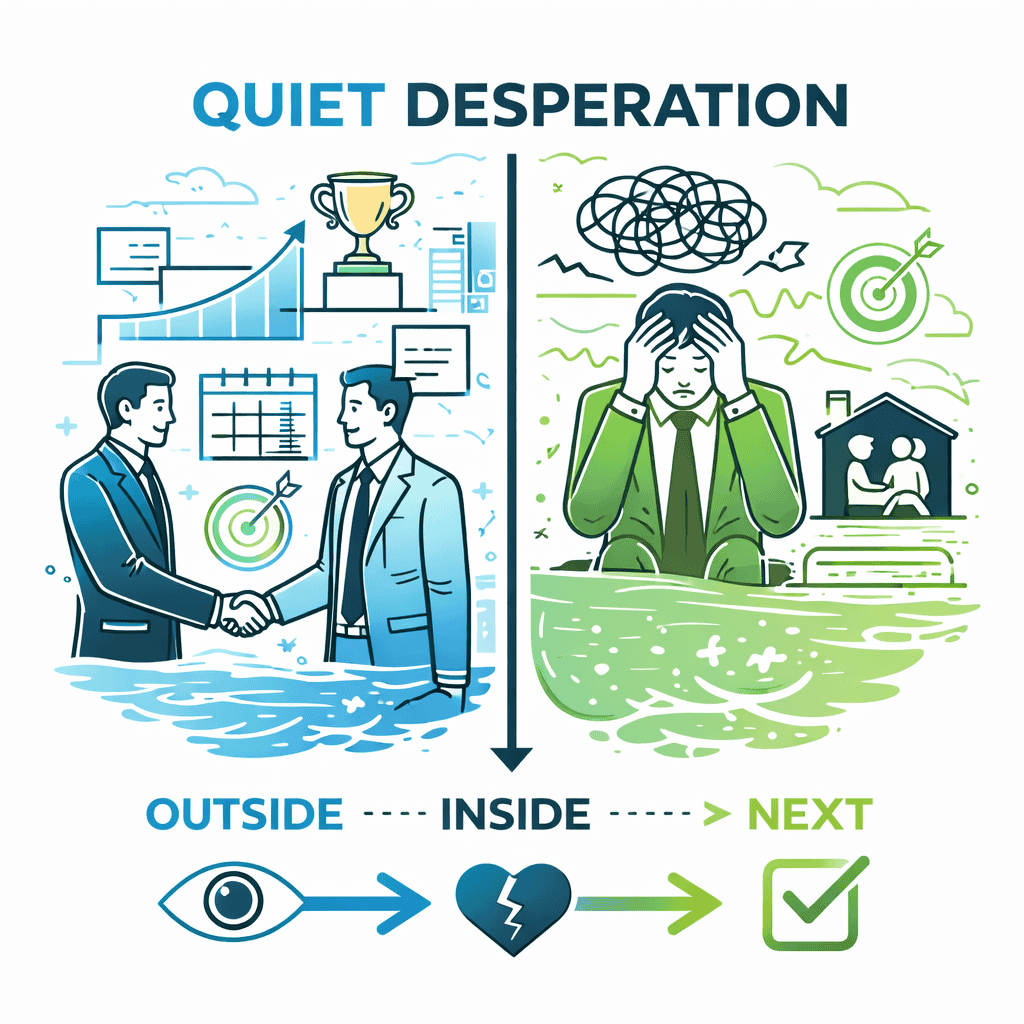
Few business people set out to build a life that feels out of order. In fact, high performers crave order and control because chaos threatens everything they’ve built. Instead, many quietly play a public game called sacrifice — telling themselves they’re noble for enduring a private life that no longer works.

You didn’t aim to become overextended, disconnected, or quietly dissatisfied. You aimed for a life of satisfaction, success, and stability, with adventure on your own terms. And you achieved much of it. That’s what makes the unease so perplexing. The very accomplishments you once hoped for become stepping stones to the next level. But eventually a deeper question emerges:

When is enough truly enough?

Outside: The Picture of Success

From the outside, your life likely appears highly successful. People depend on you, and you deliver. You lead teams, provide for a family, and carry responsibilities that few people fully grasp.

Others might describe you as driven, disciplined, steady, accomplished, even admirable. And they’re probably right. The problem isn’t that this picture is false. It’s that it’s incomplete.

External markers of success — income, influence, reputation — measure output, not alignment. They show what you are doing, not who you are. In fact, the more successful you become, the more you risk being reduced to your role. Over time, that role can begin to consume the person behind it.

You may even start believing that the role is you.

Inside: The Real Picture

Inside, the experience is quieter and harder to name.

You may not feel burned out or unhappy. You may not even feel stuck. You just feel … off. Less energized by things that once mattered. Less present with people you love. Less certain about where all this effort is leading.

Joy thins. Curiosity fades. Rest doesn’t fully restore. Moments that should feel meaningful pass by without landing.

You’re not collapsing. You’re continuing. But continuing is not the same as flourishing.

To cope, many high achievers minimize their own experience: “It’s a first-world problem. Who am I to complain?” So they normalize the dis-ease and call it adulthood, responsibility, or simply the price of success.

In reality, it’s often a sign that your private life has not kept pace with your public persona. Your roles have multiplied while reflection has declined. Your responsibilities have grown while your margin has shrunk. Your competence has expanded while your connection to life has quietly contracted.

That’s the quiet part of quiet desperation. It doesn’t shout. It’s a hum in the background of an otherwise productive life.

Next: Picture This …

Once you see the gap between your public and private lives, don’t assume the solution must be drastic. You don’t need to sell the business, blow up your life, or make impulsive decisions. That only creates a new set of problems.

The real shift begins with clarity, not chaos.

Specifically, search for where your life has become reactive instead of intentional. Start small. Reclaim one area of agency:

  • Protect one block of time not ruled by urgency
  • Reconnect with something that restores you
  • Call someone who restores you
  • Act on one postponed decision
  • Say no to something misaligned
  • Say yes to something meaningful

These steps won’t fix everything. They interrupt the drift and remind you that your life is still yours to shape.

In the On-Purpose framework, clarity about Purpose, Vision, Missions, and Values are tools for creating order out of chaos. When those strategic essentials are vague, life fills itself with whatever is loudest. When they’re clear, your choices begin organizing around what truly matters.

Don’t dismantle your life. Reclaim and reorder it.

Quiet desperation is not failure. It’s awareness. It’s the recognition that success alone is not enough and that you want coherence between who you are and what you do. That desire is not weakness. It is wisdom.

Don’t settle for looking successful while feeling like a phony. A life that works on the outside and makes sense on the inside is not just possible — it’s how you make your life make sense. 

Download my 3-Step Guide for Being On-Purpose®. It’s a simple way forward, so you can enjoy your success without selling out.

Overextended: The Moment Success Starts Turning Against You

February 5, 2026 By kwmccarthy

Part 3 of the Success Without Selling Series

There’s a moment most A-list, high performers don’t see coming. You’re still succeeding. Still producing. Still getting results. From the outside, nothing looks broken.

And yet something quietly shifts.

The work that once energized you begins to drain you. The life you built starts demanding more than it gives back. You wake up tired before the day even begins. You move faster, but feel slower inside. You’re doing good work — but you’re no longer certain it’s your work.

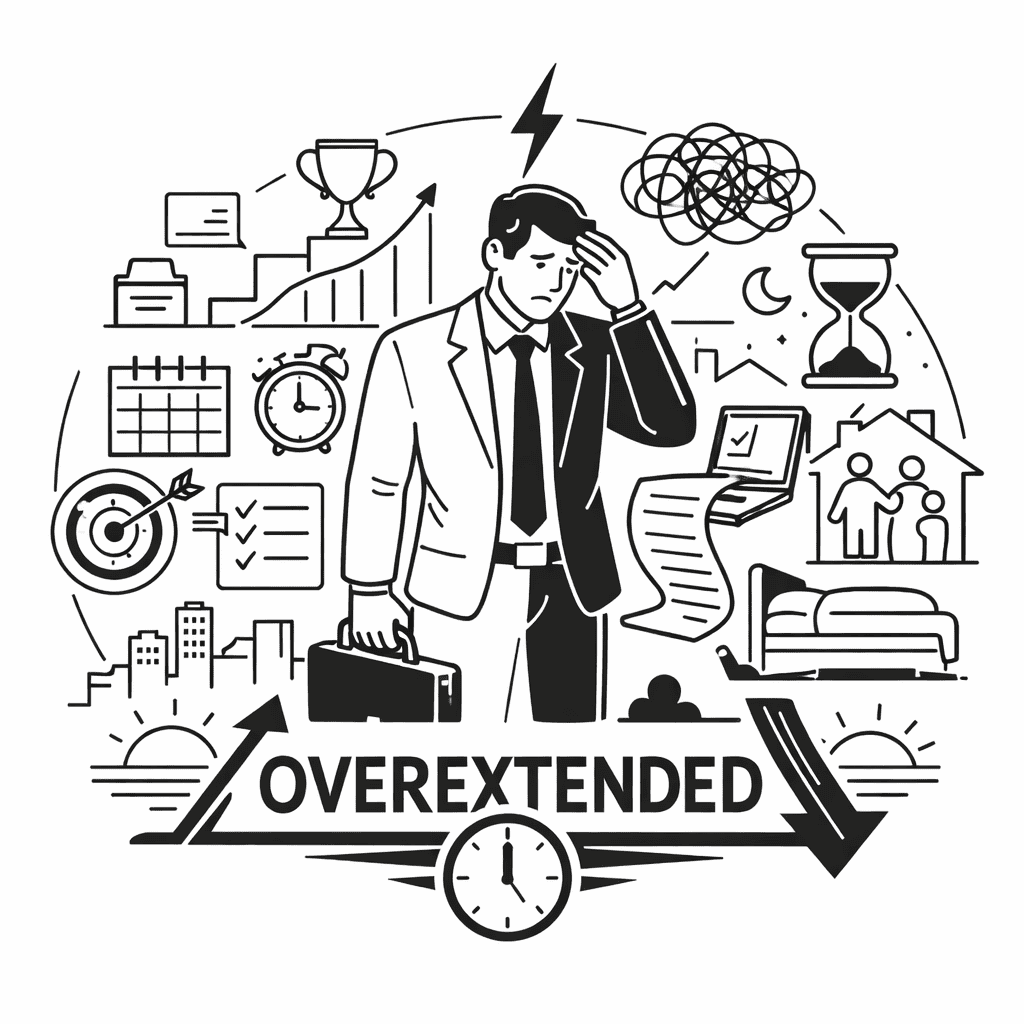
Businessman overwhelmed by stress and chaos, symbolizing overextension and burnout.

The work that once energized you begins to drain you. The life you built starts demanding more than it gives back. You wake up tired before the day even begins. You move faster, but feel slower inside. You’re doing good work, but you’re no longer certain it’s your work.

At first, you tell yourself this is just a season. Another sprint. Another quarter. Another push. But seasons come and go. Your overextension stays and grows increasingly more demanding.

When will your breaking point happen?

Here’s the paradox: you’re NOT overextended because you’re doing the wrong things. You’re overextended because you’ve been doing too many right things for too long — without a clear personal strategy for renewal, recovery, or recalibration. You’re selling out your self to your work, cause, or ministry.

That’s the subtle trap of success.

Early in your career, hustle served you well. Hard work built credibility. Responsiveness created opportunity. Reliability opened doors. You learned to say “yes,” to deliver, to perform, to show up.

And it worked.

But the habits that helped you rise can eventually become the habits that wear you down.

You become efficient.
Then efficient becomes relentless.
Then relentless becomes exhausting.

Before you realize it, your life is driven more by momentum and profit than by meaning and purpose.

This is where high performers get stuck — not in failure, but in success without order.

You’re not lost. You’re overloaded.
You’re not drifting. You’re stretched too thin.
You’re not lacking discipline. You’re lacking direction.

Even Jesus knew how to take a break. Most overextended people don’t need more effort. They think they need more rest. What they need is whole life strategy. Think of it as way to discharge in order to recharge.

In the On-Purpose way of thinking, overextension is usually a symptom of misalignment between four things:

Your Purpose — why you exist.
Your Vision — where you’re going.
Your Missions — how you spend your time.
Your Values — what truly matters.

When these are clear, your energy naturally flows in a meaningful direction. When they’re vague or crowded out by urgency, expediency and your calendar start running your life.

Here’s how overextension typically unfolds.

First, your outer life expands.
More responsibility. More influence. More opportunity. More expectations. More people depending on you. More doors opening because you’re capable. Success! You’ve arrived.

Then, your inner life contracts.
Less margin. Less silence. Less reflection. Less joy. Less presence. Less sense of who you are beyond your roles.

You’re still impressive on the outside — but smaller on the inside.

You begin to live tactically rather than strategically. Your days become a series of reactions: meetings, emails, fires, requests, decisions, deadlines. You move from task to task, but rarely step back to ask the deeper question:

Is this life I’m building actually the life I want to live?

Overextension isn’t cured by time management. It’s cured by knowing who you are deep down.

You don’t need a better calendar.
You need a more solid cornerstone to your existence.

In my work with the highly successful, I often see three quiet warning signs that success is starting to turn against them. Test yourself:

  1. Your energy is thinning.
    You’re not burned out yet — but you’re no longer lit up either.
  2. Your relationships are getting leftovers.
    You show up physically, but not fully.
  3. Your decisions are reactive.
    You’re solving today’s problems with quick fixes with less regard to shaping your tomorrows.

None of this means you’ve failed. It means you’ve outgrown your current way of living.

Overextension is not your enemy. It is your signal. It’s your life inviting you back to purpose. Back to order. Back to intention.

The way forward is not to do less randomly. It is to do more of the right things more intentionally. Start by clarifying your 2-word purpose — the simple statement of why you exist. When your purpose is clear, your decisions get simpler. You say “yes” with conviction and “no” with peace.

Then be strategic instead using hacks. Articulate your Vision, your Missions, and your Values so your time serves your life, not the other way around. Invest your remaining years instead of spending them.

Finally, make your declaration to live on-purpose rather than overextended or some other off-purpose detour.

You don’t need to quit your job.
You don’t need to dismantle your life.
You need to reorder it around who you truly are and want to become.

Overextension is not your destiny. It’s a chapter, not the story. You get to write the next chapter and the next chapter after that. Or, you can bookmark your life today and close the book on your life.

Download A 3-Step Guide for Being On-Purpose®. It’s a simple way forward so you can enjoy your success without selling out.
When Success Starts to Feel Like Selling Out

January 27, 2026 By kwmccarthy

Man sitting at a cafe window overlooking a bustling city street with taxis and pedestrians.

What happens when from the outside, your life looks good; your work and you are highly respected; your calendar is full, your income is solid; you’re productive, reliable, and admired; and by most measures, you’re succeeding.

But something is off. “Selling out,” in this context, isn’t a matter of greed, moral failure, or succumbing to bribery. We’re not talking sinister motives. You’re a good, upstanding person.

Nothing dramatic happened. Nothing was suddenly broken. It’s just this persistent unsettling sense that something feels out of order in your approach to life. 

Selling out is something subtler and all too common. It is more like “How did I end up here?”

What “Selling Out” Really Means

Selling out isn’t about making money or achieving success. It’s about small compromises over time that eventually led to being in a place never intended. Accompanying this can be a forlorn sense of a lost dream or an out-of-character fear of rocking the boat. 

Selling out involves quietly exchanging something (or someone) that truly matters, such as your values, your standards, or your sense of self for external rewards like approval, status, or security. What’s fleeting is chosen over the enduring. 

It doesn’t happen all at once. It happens in small, seemingly logical decisions over time with the compound effect catching up with you. It happens when you are:

•       Saying yes when your gut says no
•       Staying busy to avoid pondering deeper questions
•       Accepting work that pays your bills but drains your soul  
•       Engaging in entertainment while neglecting responsibilities
•       Convincing yourself “This is just how it is right now” 

From the outside, it plays as progress.
From the inside, it lands as distress.

What Selling Out Is Not

You can be successful, busy, and well compensated without selling out. Selling out is not lack of ambition or responsibility. It’s not forgoing your family or failing to get the job done.

Selling out only occurs when success comes at the expense of your identity and purpose. It happens when what you’re doing no longer reflects who you are or who you’re becoming. And it eats away at your spirit and you start disliking who you are becoming. 

The Quiet Warning Sign

The most reliable signal that you’re selling out isn’t guilt or stress. It’s numbness, a secret apathy that’s set in. You care, but you really don’t care. The emotional disconnect is real. You’ve fallen out of love.
You stop asking Is this still worth it? And you start asking Is this how I want to live the rest of my life?

You discount those questions with But I don’t really have a choice.
That’s when settling and accepting has become your unsettled way of life. 

Why High Performers Are So Vulnerable

The problem is that your success keeps rewarding the very behaviors that created your disorientating condition. Your outer, public persona demands growth and expansion, while your inner life can’t keep up and quietly shrinks for fear of exposure.

It isn’t failure. It is success at something that no longer fits. It is climbing the proverbial ladder of success, peering over the wall, and questioning, Is this what I’ve been working so hard to achieve all these years? In other words, the reality didn’t meet the anticipation. 

Reframing Success without Selling Out

Success is no longer what you can accumulate. It’s become not betraying who you are. In a word: authenticity. No more faking it, impostor syndrome, or playing an ill-fitted role. You’re stepping up to be the leader of your life. 

Here’s six authenticity anchors:
1.     Integrity over optics  
2.     Sustainability over expediency  
3.     Stewardship over indifference  
4.     Meaning over materialism
5.     Strategy over trial and error
6.     Simplicity over complexity

Why On-Purpose

Being On-Purpose happens when success is defined internally and expressed externally with intentionality. Selling out happens when success is predominantly defined externally.

Don’t step back. Don’t abandon ambition, making money, or career advancement. Far from it. Roar into the marketplace. However, step up. Broaden your definition of success so your inner life can comfortably sustain your outer life. Grow up by getting your life in order, on-purpose. 

Be On-Purpose!
Kevin

Download for Free:
A 3-Step Guide to Being On-Purpose: Success without Selling Out

How To Be On-Purpose in Business & LIfe

June 25, 2024 By kwmccarthy

Kevin McCarthy speaking about purpose in business and life.

You never really know how your work touches another person’s life.While I’ve known Dr. Jim for over 30 years, I had no idea until this interview the impact of our working together on his 2-word purpose. Here’s the interview in its entirety.

Jim, as you’ll see, is a bright guy with a curious mind and a steward’s heart. His strong Christian faith comes through in this interview — as does mine. Thanks to his inquisitive mind, we go deep with some on-purpose principles. Given our relationship, there’s a natural comfort in our conversation, which I hope translates into a deeper appreciation and application of your 2-word purpose.   As always, your comments are welcomed.

Be On-Purpose!

Kevin

Dr. Jim Harris

Do You Want More Balance in Your Life?

December 4, 2018 By kwmccarthy

Be sure to check out the free offer to download Kevin’s poem: A “Balanced” Life at the end of this post!

It seems that everyone wants more balance.

People want:

  • A higher checking account balance
  • A perfectly balanced body
  • A balanced diet

So doesn’t it make sense that one would ask, How do I find balance in my life? A balanced life flows logically and seems so attuned with the natural order. Life coaches, executive coaches, self-help gurus, counselors, and therapists galore teach the overwhelming benefits of having your life in balance. Being well intended doesn’t replace being well thought out about such a central concept of personal and leadership development.

Work–life balance is in high demand.

But do you have a true definition or image in your mind’s eye for what constitutes a proper work–life balance definition? Experience tells me that most people love the idea of work–life balance, and they’re seeking and investing in tips and techniques all too regularly but not getting the results they want. Let me save you some time!

Do not seek balance in your life. It will misdirect, confuse, and frustrate you. It doesn’t work, period. Instead, integrate your life with your purpose being the point of integration.

“So why, Kevin,” you may ask, “are you such a contrarian?” No, I didn’t wake up on the wrong side of the bed. I’ve studied, observed, and thought about this concept of living a balanced life for decades.

Balance is a physical concept that cannot adequately grasp or reconcile with spiritual realities.

Balance falls far short, yet it remains the popular culture ideal of enlightened living. In fact, it is hogwash!

A life in balance is a myth.

It is one of those feel good, happy distractions that just doesn’t work. People who are busy balancing their lives often miss it because they’re so busy thinking they have to have their life together before they can go forward. Not true! Another myth!

Doing life is learning life. Sitting on the sidelines waiting for the perfect moment of balance and harmonious happiness is wishful thinking, at best, and wasteful thinking most of the time.

Others will claim to be so busy, overworked, and stressed that they believe more balance will finally bring them the peace, comfort, and security they’re working so hard to achieve. Wrong! Today’s On-Purpose Minute points out the folly of that line of thinking.

In another On-Purpose Minute titled “Do You Want A Balanced Life?” I invite you to really consider what you are seeking. Below, you’ll find a link to download my poem titled A “Balanced” Life.

My hope is that you’ll find that striving for balance is a frustrating folly not worth the effort.

I’ve played the “balance your life game” in the past. No more!

Today when someone says “I want more balance in my life,” I actually hear an absurd statement. You might as well say, “I’m hoping to walk to the edge of the earth one day and be able to look over it to see what’s there.” No Virginia, the world is not flat.

The concept of balance in your life is equally flawed thinking despite being so broadly accepted.

So allow me to release you from the relentless pursuit of a vaporous standard that’s impossible to grasp yet seems so easily within reach. Why live in the unhealthy definition of stress, which is what pursuing a life of balance creates?

Instead of wanting more balance in your life, seek to integrate your life around your purpose, then live into your purpose, i.e. being on-purpose. This isn’t semantics; this is a seismic truth that provides order, focus, and clarity—and, thankfully, a healthy dose of “being out of balance.” You’ll learn to live with the joyful intensity where being “off balance” doesn’t matter and being true to yourself and more on-purpose does matter.

Replace your tiring, old concept of balance in life.

Change your “ideal” and you’ll transform your life for the better as you integrate your life rather than balance it.

To download my poem A “Balanced” Life, go to our shopping cart to get your free copy.

Is Fear Avoidable?

November 1, 2018 By kwmccarthy

My research with over 850 small business owners reveals that 32% of the respondents say fear is their greatest obstacle to success.

So what is it with fear?

Can we avoid fear? How do we overcome fear? Is fear really, as the old acronym goes, False Evidence Appearing Real?

In this On-Purpose Business Minute, let’s address the question Is Fear Avoidable? After watching the video, read The 7 Most Common Fears Business Owners Face and what to do to conquer them.

The 7 Most Common Fears Business Owners Face

  1. Fear of rejection
  2. Fear of success
  3. Fear of failure
  4. Fear of exposure for who I really am
  5. Fear of looking stupid or incompetent
  6. Fear of what they will think of me
  7. Fear of making money and exploitation

Overcome your fears using the “For PETE’s Sake” Approach described in The On-Purpose Business Minute:

  • Perception
  • Emotion
  • TrainingFIT 4 LEADING
  • Experience

Many fears are unnatural but very real to us.

Generally, for every fear you have, someone probably makes a living from it. So what is it they have that you don’t? Oh, For PETE’s Sake, they don’t have a thing on you. They simply have an abundance of improved Perception, Emotion, Training, and Experience. Your fear is their joy! How remarkable is that?

Dig into this topic more by reading FIT 4 Leading. This is the least known of my books and part of the On-Purpose Leadership Series. At only $10 plus shipping this small but powerful book provides you with strategies to be a better leader of your life for the rest of your life. Use the link to the book to find a free, introductory webcast at our shopping cart or visit the website.


Can I Profit AND Gain My Soul?

September 27, 2018 By kwmccarthy


The 3 Tips for Profiting The World AND Gaining Your Soul

  1. Guard your heart
  2. Focus on the soul of people
  3. Be about excellence on-purpose

In the book of Mark (8:36–37) it reads, “For what shall it profit a man, if he shall gain the whole world, and lose his own soul? Or what shall a man give in exchange for his soul?“*

Here is a sharp warning about allowing the pursuit of such fleeting things as money, advantage, pleasures, and fame to so cloud our being that we yield our character, personal leadership, respect, dignity, and relationships. We are wise to take heed because worldly temptations are alluring, but they may not be profitable.

Alarmingly, in that last phrase in Mark, there is an oblique reference to an inevitable transaction—you will have to exchange something for your soul. What will that be?

Does this mean that profiting and soul-losing are inextricably one?

I say, “No!” We can have both. We’re designed for it. In fact, to gain our soul and profit the world is the truest standard of living. Proof: how many times have you said you want to make a difference or make a contribution in your life or your livelihood?

How many times have you felt conflicted between balancing your life and your work? (Remember that life-work balance is a myth.) Purpose integrates your life and work into a meaningful whole.

So here’s the crux of the matter—you must choose which master you will serve first and foremost.

  • What is the exchange you’re willing to make for your soul?
  • Will you first serve mankind or make a profit?

There’s a reason that your personal 2-word purpose statement has a generic beginning of, “I exist to serve by …” That’s a big hint in terms of my recommendation.

After watching this On-Purpose Business Minute, please share your thoughts in the comments section below.

  • What’s your take on the matter of gaining your soul and profiting the world?
  • Do you have an example of someone who is doing both with excellence?
  • Where is your greatest struggle with integrating what seem like two opposing masters?

* The Message is a modern translation that uses more common language to bring forth powerful principles and insights found in scripture. Here are the same verses from The Message:

“What good would it do to get everything you want and lose you, the real you? What could you ever trade your soul for?”

Are You Prepared To Lose To Gain?

September 11, 2018 By kwmccarthy

In today’s On-Purpose® Minute, let’s explore the gains to be found in loss! You might be surprised just how effective loss can be to our long-term benefit.

How do you deal with loss? What is loss?

Are you prepared to have loss in order to gain?

Locallygrown-produceCould it be that loss and—more importantly—learning how to deal with loss are simply as organic to life as the vegetable section at your local Whole Foods store?

In The On-Purpose Person, I reference fighters, floaters, fleers, and flitters as “styles” for dealing with stress and life. There, you’re encouraged to be a navigator, one who leads and manages through change rather than reacting to and being a victim of it. It takes an inherent calm and peace.

As a formerly ranked tennis player, when I have been in “the zone” on the court, I play without the stress and strain of forcing my play. Things just seem to click better. The secret to getting and staying in the zone to some degree is detaching from the usual expected outcome—to win the match.

The ability to play better comes from navigating the experience positively. It is hard to keep this “above the fray” mindset, but when one does, the body and mind are able to perform seemingly without effort.

In business, on the tennis court, or on the golf course, I’ve seen far too many talented people tighten up for fear of loss. This “choking” isn’t a personal failure; it is a growing experience if we allow it to be instructive versus destructive.

Oddly, loss is important to our health, well-being, and finances because it helps us to mature and grow.

Sailors on a ship may not be aware of the big picture or have the experience to place what is happening to the ship in a proper context. A ship’s captain, however, brings the capacity to navigate the shoals and shores safely even in a storm.

If you are learning—and we’re all life-long learners—then anticipate there are situations when you are a sailor and other times when you are a captain.

Learn from your losses, and your life passage will be calmer and more productive as you gain from each loss.

  • Page 1
  • Page 2
  • Page 3
  • Interim pages omitted …
  • Page 12
  • Go to Next Page »

Footer

Search this site.

  • Making Meaningful Money™
  • Leadership Mettle™
  • Booking Kevin
  • About Kevin
  • Endorsements

Copyright © 2026 · Kevin W. McCarthy, Winter Park, FL