• Skip to main content
  • Skip to footer

Kevin W. McCarthy

The Professor of On-Purpose

  • Book Kevin to Speak
    • Programs
    • Be On-Purpose®
    • Making Meaningful Money™
    • Leadership Mettle™
    • TOUGH SHIFT®
  • About Kevin
    • Endorsements
  • Blog
  • Search

kwmccarthy

How Good Are Your Questions?

August 14, 2018 By kwmccarthy

Is the mark of a leader his or her ability to give solid answers or to ask great questions?

In this On-Purpose Minute, ask yourself if you are interested in exploring some of the benefits of being one who listens when others are talking. There’s much gain from planned silence and saying nothing.

——-

The Power of Nothing
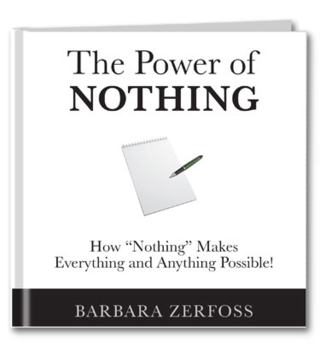
Barbara Zerfoss is a personal and professional friend. I highly recommend her wisdom and insights found in The Power of Nothing. Click the book cover to order. Kevin

Along the lines of having an open mind, my good friend and business colleague Barbara Zerfoss wrote a Simple Truths book called The Power of Nothing.

The book starts with a simple, yet powerful premise … we can start anything in life or business with a blank slate. Too often we bring along a matched set of psychological and relational baggage and preconceived notions that get in the way of true progress and doing what’s right.

The back cover says “Whatever your background, you can choose to create the future you desire from a blank sheet of paper. The past doesn’t exist, and the future hasn’t happened yet.”

So what are you waiting for? Nothing to it … just buy your book today!


Salesperson Turnover? Why it matters.

August 9, 2018 By kwmccarthy

Salesperson turnover is a consistent problem in businesses small and large.

Being a salesperson is a tough profession. It is typically hard work requiring a variety of skills that can often be contradictory within one person. For example, one needs to be persuasive and a leader, yet also a good listener and a servant. The On-Purpose Approach reconciles many of these qualities by placing purpose first and foremost.

Today’s On-Purpose® Business Minute explores 3 important elements to set up salespeople (and solo owners) for success and avoiding salesperson turnover.

  1. Culture of belief
  2. Marketing
  3. Sales training

Salesperson turnover costs everyone. Rolled up paper money of various dollar amounts.After decades of advising thousands of business owners, the patterns of poverty jump at me. If you are a business owner, sales manager, or a salesperson, then pay close attention to this message. Benchmark yourself against my comments and see how well your selling system operates to support your field. Perhaps there’s a reason why you can’t find and keep good salespeople!

If you are a Solo Owner, then benchmark yourself against these three measures.

Being the salesperson and the production person presents a unique challenge. Far too often I see small business owners veering into the realm of thinking, Yeah, I think I can do that.

Instead of staying with what one does best and finding clients who truly value your services and where you are expert, we drop down the learning curve and grab work for the money instead of realizing we’re losing profitability and diluting our brand by confusing our target audience. It is a dangerous cycle of being money-driven instead of being on-purpose.

Be On-Purpose!

Kevin TOPBP_cover


Want to learn more?

Purchase your copy of The On-Purpose Business Person. Click on the book cover to order.

Are Your Leadership Skills Maturing or Just Growing Old?

August 7, 2018 By kwmccarthy

Are you maturing as a leader or just getting older?

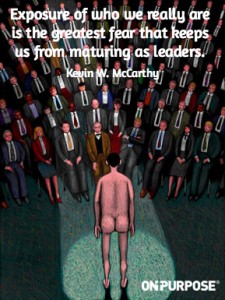
The fear of being exposed for who we really are is likely the greatest fear gripping us and keeping us from realizing our leadership potential. This is especially true for those who bought into the lie of “fake it until you make it.”

Even a “successful” life built upon posing and lies lives in the shadow of discovery. Immaturity causes us to be afraid of what other people will think of us. This sophomoric pride keeps us from growing, improving, and Fearofexposuretesting ourselves at the next level.

On the other hand, none of us are perfect. In effect, we’re all goofballs at some level in some place at some time. So get over the pretenses of perfection and live into the real you. Being authentic is in the foundation of great leadership qualities.

So how good are your leadership skills and, importantly, your leadership attitudes?

Are you …

  • Learning (for a lifetime)?
  • Leading (your life so others want to follow you)?
  • Loving (unconditionally)?
  • Leaving (the world a better place)?

Many cite the absence of leaders today. Actually, we’re suffering from an absence of mature leaders stemming from the reality that we’re still trying to figure out what to do with ourselves when we grow up.

Certainly, there’s a benefit to having a childlike curiosity and faith. But let’s talk growing up here—stepping into adulthood with both feet firmly planted on the ground as a leader of one’s life who is growing in experience, wisdom, discernment, and judgment.

Our dearth of leaders may well reflect deeper challenges—the absence of mentors and the value of relationships over time. Accepting those rationales, however, are excuses. If you want to be a leader, you’ll find the mentors, experiences, and relationships that will grow you so you are learning, leading, loving, and leaving—the four attitudes of mature leaders.

At On-Purpose Partners we serve up heaping portions of maturity through our one-on-one On-Purpose Executive and Personal Coaching Programs. Is this your time to nakedly take your place in the front of the pack?

Is More Money Your Answer?

August 2, 2018 By kwmccarthy

Ask most business people what they need and the likely answer is “more money!” That’s like asking a football coach what he needs: “More points to win the games.” The real issue is What does it take to produce the points or the money?

Money (or points) is a self-deceiving answer or an easy target to articulate.

While Stephen Covey’s Habit #2 is “Begin with the end in mind,” it is as promoted just a beginning to the end. When we only have the “end in mind,” shortcuts are probably even ethical compromises.

The “Management by Objectives” movement has suffered many of these challenges. While never the intention of its creators, it became a rationale for sloppy management and the abdication of leadership and strategy.

Having worked as and with business owners for five decades (I started very early), I can tell you that money may be the obvious answer, but it is rarely the right answer.

Money is a specific commodity with well-defined functions, mostly as a measure.

Oddly, the lack of money in business may be more valuable than the money itself. It forces us to get real, to be creative, and to assess what’s working and what isn’t working. In the end, we’re apt to become better prepared and more capable of adding higher value and better services at a lower cost. Ergo, we make more money.

Being in business provokes us and pushes our buttons emotionally.

I’m not saying go out there and look to take stupid hits. On the contrary—avoid them, but some number of hits are inevitable. Rather than letting them take you down, let them build you up by learning, growing, and maturing.

In this On-Purpose Business Minute, I’m sharing with you the three most common attributes that attract money to businesses: law, order, and opportunity. If you’re a business owner or entrepreneur, this is a must see Minute.

Need some help with your business? On-Purpose Business Advisors has worked with start-ups and entrepreneurs to Fortune 100 CEOs. Email me to learn more.


Resource

Invest 9 minutes to learn about The On-Purpose Business Plan. This maps out the essential infrastructure to create sustainable growth and profitability.

click chalkboard to enlarge


Are You A Success and Feeling Successful?

July 31, 2018 By kwmccarthy

Success takes on a different meaning for each of us.

For those of us with high and noble ambitions success is mostly momentary. Success opens our eyes to new vistas off on the future horizon that are only reached by going back down the mountain, into the valley, and climbing the next higher mountaintop. It’s work disguised as adventure and the exploration of possibilities.

Far too often I suffer from feelings of failure because of all that I imagine and have yet to accomplish.

Recognizing success is different, however, from resting in it.

It’s odd how sometimes I can be restful and satisfied, yet at other times so restless and frustrated. What gives with that?

Unfulfilled ambition easily draws me into being a smaller, stingier, melancholy occupant of my being. I don’t like me in these flashes of embracing failure. My 30-plus–year quest of pioneering the planet to be on-purpose continues to be a financial battle to fund the next project on the horizon. Fighting feelings of frustration, nonrecognition, and financial shortfall wear away at my heart in doses of discouragement.

When I find myself tending toward hoarding and worry, I know for a fact that my better character is not at work. That devil of fear is pounding on the door of my heart and I have to decide whether to let him enter or tell him to go away.

To regain my sense of perspective and rejuvenation, I force myself to reconsider my personal and professional accomplishments over the long haul. Counting my current blessings fills me with a gracious gratitude and a spirit of generosity.

Whether it be 30+ years of marriage, a son and daughter who make me proud, two truly best-selling books in The On-Purpose Person and The On-Purpose Business Person, and more—much more—I’ve learned that none of “my success” was done by me alone. I’ve been forever surrounded by a supportive cast of family, co-workers, friends, classmates, and colleagues who’ve each invested in my work and life. Love has uplifted everything “I’ve ever accomplished.”

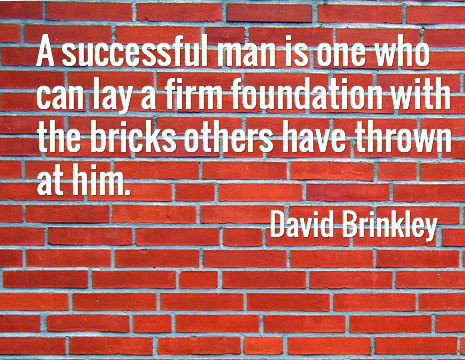
Success QuoteI’ve also dealt with people who “throw bricks” by stealing, cheating, lying, and taking advantage of me when I trusted. About every 7 years I get a major AFGE (Another Frigging Growing Experience) that keeps me from a sense of self-importance.

These “lessons” have made me wiser and stronger.

The biblical concept of the tithe (See The On-Purpose Person in the chapter titled “Giving”) is remarkably practical on this point of managing success and failure. Tithing is designed to be a joyful, intentional, and proportional (10+%) expression of our time, talent, and treasure (our success). For our benefit, the tithe offers us a periodic and healthy time for reflection regardless of the size of our accomplishments.

Giving can be off-purpose when used to control, manipulate, or lord it over another. Giving is free and without strings attached. Investment, however, comes with expectations, controls, terms, conditions, and covenants. You can be a giver and you can be an investor—just acknowledge the difference when you’re in the act.

When giving, discretion and discernment are our allies. Stewardship matters. We’re not to be gamblers in our giving but we are to take risks by stretching our comfort zones so our faith and trust are extended.

Giving freely, not from duty or obligation, is the healthy outpouring of a successful soul. This kind of success and giving are knit together. You can’t have one without the other. As my friend Steve Brown of Key Life Ministries would say, “Now, you think about that.”


Do You Have Killer Goals?

July 26, 2018 By kwmccarthy

“You need to set goals.” In business and in life we’ve all heard those words. It is hard to argue with the advice. It seems so simple. Yet for all the talk of goal setting, how effective is it really?

Setting goals is an important aspect of the strategic planning process.

But it is part of a process, not the ends and means unto itself.

Several years ago the CEO of a multi-billion dollar publicly traded company hired me to help revive the business. As he said to me, “Kevin, we need a crusade. Something we can believe in that’s bigger than our day-to-day.”

During my on-site time at the company headquarters, I met with the Director of Worldwide Strategy. In gathering initial information, I asked this question: “What are your income and profit goals for this year?”

That’s normally not a challenging question. Except here I was met with the answer, “We don’t have any goals like that.” This was a stunning revelation to me. How could they not have goals?

I promise you that the point of this On-Purpose Business Minute is an endorsement for setting reasonable goals but within the context of a strategic planning process. In my client’s case, it had me wondering just what the heck the Director of Worldwide Strategy was doing. He wasn’t happy to see me show up in the first place and now this question ensured a sabotage was in the works. He won!

Setting goals in a new fiscal year is commonplace in most work settings.

It is the natural time of the year for reflection and planning so the new year can be better than the previous year. There’s a reason why, however, all those good intentions often fail to live up to expectations. Business can’t be run by numbers alone. Metrics have a role, but they’re the result of a strategic process, not the lead.

This form of “Management By Objectives” was made popular in the 1970s. However well intended it was, the execution of it fell to a minimalist “numbers only” approach. Unfortunately, that is an indication of under-performing management.

Goal setting — everyone uses it, right?

You know the routine. You show up at an organizational retreat for work, church, the PTA, a ministry, or some other group. After the introductions, the person with the agenda says it is time to set goals.

Suddenly a knot appears in your stomach. Something about this doesn’t feel just right. You go with it because goal setting seems so right … and yet so wrong. After an hour or so, the team comes up with a list of goals and everyone goes home satisfied that a great deal was accomplished. And it has, but you have this gnawing feeling that very little is really going to happen next.

Why, you wonder, is it so unsatisfactory? Why is the group so excited, yet you’re so worried? You understand that goals without a plan are merely imaginary—but still better than no goals at all! Regardless of whether the organization is falling short or falling flat on its face, it is failing to complete the strategic process. That means that someone in charge doesn’t really know what it means to lead an organization. Uh-oh—Killer Goals of the worst kind.

There are Good Killer Goals!

Here’s an example from when we were in active production of The On-Purpose Minutes. Our killer goal was to produce and post an original On-Purpose Minute every Tuesday and an On-Purpose Business Minute every Thursday.

Sounds easy enough, right?

Hold on for an On-Purpose Minute! Consider the creative thinking, planning, equipping, and many disciplines needed to meet this simple “killer goal.” I invested nearly a year in researching, experimenting, and learning what camera, lighting, and editing software to use. In the end, the technical and production stuff is actually the easy part.

The concepts and brand of the On-Purpose Minutes had to be conceived, developed, and tied to the business strategy of On-Purpose®. An audience to reach had to be in mind. Finally, the content for each On-Purpose Minute had to be conceived, written, recorded, edited, posted, and embedded using YouTube.com and my blogging service.

Here’s one example where a Killer Goal with a clear purpose, plan, people, and process to support performance produced a video library of over 200 Minutes.

Avoid setting Killer Goals that kill the team.

Take your leadership and management duties seriously so your team can thrive and exceed its goals. Learn to think more deeply about the breadth and depth of the assignment.

The more you can talk about and plan early on, the better things will go for all involved.

Learn that the slow path to achieving your goals is almost always the sustainable and more profitable fast track for reaching your Killer Goals.

Be On-Purpose!

Kevin

What Is A Vision?

July 24, 2018 By kwmccarthy

Vision is a gift to look into the future with a creative clarity and belief that what isn’t will one day become.

Vision comes in many forms and manners. Vision is larger, much larger, than a goal. According to The Book of Proverbs, vision is what prevents us from perishing. Vision is personal, yet it can be shared and can engage a group to greater heights.

What's Your Vision? Vision is a gift to look into the future with a creative clarity and beliefe that what isn't will one day become. Lump of clay resting on drawing of a light bulb.Vision is the second of four key strategic concepts for better leading one’s life, family, and/or organization. In context and order, here are these what I call “deep strategy” concepts: Purpose, Vision, Mission, and Values.

If you’re asking about vision, then you are likely in the midst of seeking a deeper understanding or clarity related to direction. Vision answers one of The Great Questions: Where am I going?

What is a vision, really?

If you’re confused as you read books or surf the web, then you’ll only be more confused. Sadly, there is no standard accepted definition for vision or its related strategic concepts of purpose and mission. We’re doing life and business in a Tower of Babel world. Our language is confused around these vital concepts. By casually comingling and using them synonymously, all of society pays the price for the confusion and poor communication.

Businesses are big about stating their visions.

Many a business person will tout their vision with flair and enthusiasm. Bravo Business Person! But wait, there’s more.

  • Vision without purpose is just a costly distraction.
  • Vision without missions and plans is just wishful thinking.

Purpose, vision, and missions need values to govern them toward the common good.

In the absence of standards, for over three decades, I’ve led the charge to fill the void by offering a standard in The On-Purpose Person and The On-Purpose Business Person. Meet The On-Purpose Pal—a cartoonish character who provides aTOP Pal 2013 copyright simple sense of how purpose, vision, mission, and values are different, yet connected.

There’s much to learn about purpose, vision, missions, and values.

This post isn’t the forum, but let me give you one way to better understand what you’re wanting to know. Answer the following “Who am I?” questions and you’re on the road to what you’re really after—a life of meaning and purpose with a clear identity, direction, plan mixed with strong confidence, and hope for the future.

  • Purpose: Why am I here?
  • Vision: Where am I going?
  • Mission: How will I get there?
  • Values: What’s important along the way?

Answered these questions? You’re well on your way to being an on-purpose person in creation.

Story: Trusting One’s Vision

Vision can be cooped up inside us longing to escape if we will just dare to express it to the world.

Years ago one of our certified On-Purpose® Professional Coaches was working with a woman who shared a vision for an inner city orchestra. At the time the client was a single mom working two jobs and caring for her two children. Dreaming was a luxury this single mom believed was ill-afforded to her. With some gentle prodding by my associate, the client risked putting words to paper. Her vision began to take form. Cautiously, she began to share her vision.

Remarkable events unfolded within three weeks. At church one Sunday, a local high school principal approached her with this statement: “I heard you are gifted with teaching music.”

“Yes,” was her simple response.

The principal continued, “Over the summer, my high school received funding for an entire orchestra. I have stands, instruments, sheet music, and an acoustically designed studio. But guess what I don’t have? Someone to develop and lead the students. Would you be interested in the position?”

The rest of the story is one that ends happily.

So, what is your vision?

Are you prepared to allow the world to conspire for your benefit? Share your vision in the comments section. Who knows what might happen if you do.

Tip: The On-Purpose Poster provides a more in-depth description in a four-color 11″ x 17″ format suitable for framing. At checkout, let us know if you want your poster personalized and signed.

Just Because We Can, Do We?

July 19, 2018 By kwmccarthy

Spread way too thin?

Does your “To Do List” look more like an “It’ll Never Get Done List”?

Welcome to my world where I have

  • more ideas than time
  • more projects than production capacity
  • a willing work ethic that admittedly tends toward workaholism

Who in your life is asking you this question: “Just because we can, do we?”

As a business advisor who develops deep strategy and designs businesses, I’ve seen far too many entrepreneurs and business owners confuse their capacity to perform as their reason to perform.

“We can do that!”

Having the ability to do something isn’t necessarily a sound reason for actually taking it on. I’ve been learning to be far more judicious about what I do. I also keep an “Ideas” file. Placing my scribbles and thinking into notes and notecards tends to discharge the energy or the immediacy and provides a cooling off period where perspective can be gained and better judgments made about what matters most.

Admittedly this is easier to write about than to live into.

The phone rang from a new business advisory client. I took the call. The business was in a revenue freefall.

  • Sales had dropped from $220 million to $70 million.
  • The business fundamentals had changed.
  • The unexpected death of the co-founders created chaos and confusion.

The young new family ownership was unprepared to lead or manage a business of this scale. Something had to change—fast!

The business had many functional strengths in operations, finance, facilities, brand, and such. Tremendous business capacity resided with relatively very sound infrastructure. They could do business, but could they remain in business?

Business is an inside-out reality.

What’s happening within the business is reflected outside the business. Customer engagement is important; however, it is leadership and management who create the means for that engagement to shrivel or thrive.

Marketing, in this case, had never been strategic. The deceased owner had a knack for it. Today, no one was at the helm with a feel for the business. In short, the company was in the midst of a very costly identity crisis that affected the internal culture and marketing. The customer experience suffered and very predictably, sales plummeted.

Working with the new owners and the hired president, we crafted a heartfelt purpose, vision, missions, and values. Then we partnered to develop a business plan. It rippled into a renewed marketing plan, sales plan, sales tools, sales training program, and field train-the-trainer program.

Let’s just say, probably a million dollars was invested in the entire project by the time we were ready to launch.

The relaunch date of the company was set. Company-wide months of thought, effort, and resources had been poured into this push to reinvigorate the business. A special convention was called to unveil the months of planning and preparations.

The week before the big relaunch, the company president attended a technology conference extolling the opportunities to be found in that industry, an unrelated business. The president, however, figured, “We have a loyal customer base and the capacity to attempt this. They’ll follow us.” This was true, but not wise.

Over my and his managers’ vigorous objections, he hurriedly hijacked the conference agenda, threw together a presentation of his vision, and launched a business concept (no support in place, mind you, to execute) to his 500-person sales force flown in and housed at the company’s expense.

Need I say more! The sales force wasn’t just confused, they were red-hot angry. It was as if a “bait and switch” had happened right before their eyes. The owner was playing around willy-nilly with their livelihoods.

The day after the “announcement,” the engagement with On-Purpose Business Advisors was mutually ended. The company could pursue what eventually proved to be—no big surprise—a very costly tangent that killed trust and momentum … and eventually put the company all but out of business.

Of course, this client had a host of people telling him not to do what he was doing. He just refused to listen and paid with his family’s business.

An idea alone, even a great idea, is never justification or rationalization for starting new initiatives, projects, or companies. In most cases, investing the same effort to launch something new is more wisely invested in updating, upgrading, and deepening what exists already.

Let the simplicity of the On-Purpose business approach guide you: Do More of What You Do Best More Profitably. A great exercise for new projects or businesses is to use The Service Model to design and develop your idea.

By capturing the essence of your thinking with a consistent approach, you will be more realistic.

Then file it away and give yourself a cooling off period. Later pull it out and evaluate it against the other opportunities, projects, and ideas you have.

Personal/Team Discussion: Show and read this On-Purpose Business Minute to your team and ask the following: Considering the many projects and opportunities on our plate, assess each against … Just because we can, do we?

The drive to make money and the capacity to produce are not predictors of customer acceptance. What lessons or stories do you have to share about leading the organization?


  • « Go to Previous Page
  • Page 1
  • Interim pages omitted …
  • Page 6
  • Page 7
  • Page 8
  • Page 9
  • Page 10
  • Interim pages omitted …
  • Page 56
  • Go to Next Page »

Footer

Search this site.

  • Making Meaningful Money™
  • Leadership Mettle™
  • Booking Kevin
  • About Kevin
  • Endorsements

Copyright © 2026 · Kevin W. McCarthy, Winter Park, FL