• Skip to main content
  • Skip to footer

Kevin W. McCarthy

The Professor of On-Purpose

  • Book Kevin to Speak
    • Programs
    • Be On-Purpose®
    • Making Meaningful Money™
    • Leadership Mettle™
    • TOUGH SHIFT®
  • About Kevin
    • Endorsements
  • Blog
  • Search

Leadership

How Do I Simplify My Life?

May 1, 2018 By kwmccarthy

Have you reached the point where you’ve said, “Something has to change! I can’t go on living like this!”? You want to simplify your life, but then you mindlessly keep filling your schedule and piling up the work at home and on the job.

Life in the fast lane requires a vehicle designed to go fast. To do otherwise is simply gambling with one’s life. You may feel blessed with the desire to run in the fast lane. But you’ve also been blessed with the wisdom to know that level of activity can’t be sustained long-term without negative consequences.

No research studies here to reference, but my gut tells me many of us are looking to simplify life with the hopes that decluttering will offer stress relief, healthier living, and a more peaceful existence. We’re running so hard and so fast, that if we ease off the accelerator of our lives for a minute, we’re apt to discover we’re lost and without direction.

We begin asking basic and solid life questions such as:

  • “What does it really mean to be me?”
  • “How do I find direction in my life?”
  • “Who am I really?”
  • “How do I simplify my life?”

The desire to simplify our lives and the act of actually doing it are easily postponed. When a car needs maintenance, a dashboard light flashes on and we take it to the repair shop or dealer. When we need maintenance, we experience headaches, stress, grumpiness, and worse. Hypertension, adrenal fatigue, weight gain, and other risky decisions keep us flying down the highway of life in ill-maintained bodies. What do we do? We pop a pill to kill the pain or turn off the indicator.

Are you at risk of running yourself into the ground at a frenzied, unhealthy pace?

“Clutter equals postponed decisions.” That’s what my friend Barbara Hemphill, author of the Taming The Paper Tiger series and professional organizer extraordinaire, says about all the stuff surrounding us. In essence, Barbara’s telling us that physical clutter is a reflection of a life of indecision.

In the On-Purpose Approach, clutter is speedily and readily managed with the Want List and Tournament process. Download the free preview to the Discovery Guide. Use this simple process to sort and set priorities. In just about 10 minutes, your brain will be better organized, your spirit more settled, and you’ll move forward more productively. Use this tool every day with your Two Do lists or anytime you’ve got a project and can’t figure out where to start.

Let me offer a different perspective for you.

What if the demands, stresses, and strains of our modern society are actually blessings that refine and sharpen us to be more of who we are and are called to be? That means you are, in fact, an on-purpose person in creation. Perhaps this current crisis is really a conspiracy of compassion designed to bring you to your knees … for prayer and prayer alone. If so, count it all joy that you have hit your low point and can only look upward.

BONUS Video: Watch Michael W. Smith’s song Open the Eyes of My Heart. This worship song has long been a favorite of mine. If you’re in a dark place today or simply need to be uplifted, let the words of this song sink deep into your spirit.

How Much Planning Is Enough?

April 26, 2018 By kwmccarthy

“How much planning is enough?” is a question I’m often asked by business clients. It poses an interesting query because some of us are planners and others of us are more action-oriented.

There is a fine line between “gettin’ ready” and “gettin’ going.”

None of us are immune from the dilemma of how much is enough.

I see this in my business and life, and, even, authoring books and articles or producing On-Purpose Business Minutes.

Here’s one of my On-Purpose Proverbs on the topic. Perhaps it will give you a rough rule of thumb:

People who don’t have time to plan, need to plan more. People who have time to plan, need to execute more.

Figure out which one “people” you are and adjust accordingly!Image of businessman. "Planning? People who don't have time to plan, need to plan more. People who have time to plan, need to execute more."

Here’s a bit of a litmus test for you to see if you’ve got it right.

If your business is making sufficient revenue AND you have a high degree of personal and professional satisfaction PLUS you’re optimistic about the future, then chances are you’ve struck the right chord. If, however, the previous sentence doesn’t describe your current reality, then use The On-Purpose Proverb above to make a quick assessment of where you need to adjust your attention to find improvement.

Planning is typically considered to be in the wheelhouse of strengths for executive officers.

The reality is we all need to be planners to some degree. The difference in planning from the boardroom compared to the mail room is the scope and authority of the influence. The greater the authority and number of people following the plan, the more important the role of planning becomes to the organization.

Oh! One last thing. When doing planning, please make sure you execute on at least one thing: create a written plan, even if your plan is as simple as a “to do list” with names and dates. The “I Got It Right Here Between My Ears Plan” is really a dream without a deadline, details, and typically, satisfying results. You’re too at-risk of being distracted by shining new objects that cross your path.

“The executive of the future will be rated by his ability to anticipate his problems rather than to meet them as they come.” — Howard Coonley


Admit it! You’re prone to unproductive distractions, but chances are if you’re a person who invests time to watch the On-Purpose Business Minutes, then you’re committed to working on you, to becoming a better person and leader. What tips or suggestions can you offer us? Please use the comment section below to share your wisdom and school of hard knocks lessons learned.

Are You In The Midst Of A Tough Shift? (part 3)

April 24, 2018 By kwmccarthy

(This video was originally recorded on Valentine’s Day. Every day should engage your heart.)

Purpose is a matter of the heart!

Far too often we tend to think of the heart as a weak or soft place subject to vulnerability. Nothing is further from the truth. We’re most at risk when we don’t know the depth of our heart or who we are.

Your 2-word purpose statement is an expression of your heart that gives your head a way to use, remember, and engage the true strength of who you are. Not knowing your heart is a disadvantage avoidable only by you.

Would you like help in discovering your 2-word Personal Purpose Statement?

Go to ONPURPOSE.me. ONPURPOSE.me logoThis online app will guide you through a process of selecting a purpose statement, plus you’ll receive a 10-email course that’s practical to being on-purpose. The limited-time reduced launch price is currently available.

The graphic I’m using to illustration the heart and head relationship is called The On-Purpose Pal. He’s introduced in The On-Purpose Business Person and has advanced to a big part of all things On-Purpose. The “OP Pal” graces The On-Purpose Poster that clarifies the language of leadership: Purpose, Vision, Missions, and Values.

Are You In The Midst of A Tough Shift™? (part 2)

April 17, 2018 By kwmccarthy

Are You In The Midst of a Tough Shift (part 1)

A Tough Shift™ happens when we’re not making a smooth and peaceful transition personally, professionally, and/or corporately.

Often these transformations are due to a change in the environment beyond our control and we’re reactive.

Sometimes, however, we proactively choose to take the bull by the horns in order to improve our situation, life, or business. Either way, it is a risk that’s not easy but a decision that’s designed to hopefully improve our station or circumstance in life.

An essential element of any tough shift is the ability to have a firm grasp on reality. Hindrances such as denial, blame, and fear cloud our progress. The management of personal growth is a core life leadership skill to develop.

Businesses Go Through Tough Shifts 

The On-Purpose Business Plan provides key links from deep strategy to customer satisfaction. Here both the science of business and the art of leadership come together to create an integrated, living organism or culture. On-Purpose® has been leading this charge since the late 1980s. In recent years, the trend toward a more human and humane approach to business has emerged. Most company leaders, however, are stuck in the midst of their own Tough Shift. The old ways don’t give in to the new ways easily.

If you’ve read The On-Purpose Business Person, you’ll recall that there are “the man” and “the old man.” Here the classic battle is played out in this modern parable. Here the four pillars of an on-purpose business create the corners of building a business true to the past yet responsive to the future:

  1. The On-Purpose Principle: Aligning the Purpose of the Person with the Purpose of the Organization
  2. Think Inc!: Leading like the owner of the business — 100% responsibility
  3. The Service Model: Closing the gap from purpose to performance to serve customers and beyond
  4. The Manner: Do More of What You Do Best More Profitably

The Really Tough Shifts are Shifts in Culture

To illustrate the point on a large scale, the United States of America is in the midst of a tough shift over the prevailing culture of the country. The centerpiece of such a battle would appear to be opposing political parties and ideals. Below the political bickering is a war waging over what is the contemporary role of the U.S. Constitution — the “deep strategy” for the country. This fight is not just between the Democrats and Republicans—it is within each party as well.

Putting aside politics and looking at this from a strategy lesson point of view we can broadly see

  • The Constitutional conservatives revere the founder’s intent and take to heart the oath of office.
  • Living Constitutionalists see the document as a living, breathing document that offers structures but needs regular amending to conform to contemporary needs.
  • Populists see the Constitution as an impeding relic of the past that hobbles efforts to serve the people.

And so the child-like bickering across all candidates continues on the surface versus the depth of matters at a root level. Governing is serious business—whether it is running a country, a business, or one’s life. At some point, the adults in the room need to be in charge.

A former business partner of mine was keen to observe, “They’re looking at the hole instead of the doughnut”—his folksy way of saying people are focused on the unimportant … and it isn’t just in Washington, DC. Look in the mirror and see if your dissatisfaction with DC isn’t simply a projection of your personal dissatisfaction with yourself thrown onto an easy target.

Do you see why being On-Purpose so profoundly matters to your way of life? If you’re in a Tough Shift, don’t blame Washington, the economy, your past, or whatever else you can conjure as an excuse. It is unbecoming to you because it keeps you from becoming the true you.

Purpose Is Unchanging

Your purpose is the one place where opposing forces have the best chance to agree, or at least agree to disagree, hopefully agreeably. Purpose is this seemingly distant place from everyday life, yet this is where performance is birthed. When purpose, vision, missions, and values are confused, then the country or company (or person) are sure to be as well. Yet most discussions in businesses center around tactics in the absence of agreement about what is really most important … to inform the tactics.

Managers tend to see changes in the marketplace and the business needing to respond to such shifts strategically. Adjustments to the business of the business are much more about the science of business. Most are fairly straightforward patterns to those of us who have been around the block for a few decades or more.

For example, things are stirring at On-Purpose Partners. We help our clients to make decisions that are on-purpose. We do this as a business advisory firm by clarifying deep business strategy, design, and strategic story to feed into the corporate culture and business brand to merge into a more fully integrated customer experience (see the On-Purpose Business Plan).

A few years ago, I felt called to re-invest my time and focus on the personal leadership aspects of the business. We’ve always been about leadership—helping our client companies and individual coaching clients to be leaders in their field/industry or life, respectively. People are the essential distinctive to any organization. Healthy people are more likely to create a healthy business, period.

The world needs to be on-purpose. After over 25 years of developing all this content and writing books, we’re poised and positioned for remarkable service around The On-Purpose Principle—aligning the purpose of the person with the purpose of the organization. It is exciting, yet a tough shift filled with financial risks. I’ve been at work on this tough shift within our business for the last couple of years. Frankly, it has been slower than I anticipated, yet better than I expected. You can expect to see more offerings for individuals to be on-purpose across the world. Yes, the vision of “Every Person On-Purpose” or The On-Purpose Planet continues to inspire me.

Hopefully, today’s Tough Shift point of view has stirred some thinking for you to ponder about your life, your business, or your country.

Bottom line: These Tough Shifts are tough! I welcome your prayers and thoughts.

Be On-Purpose!
Kevin

What Is the Heart of Selfless Service?

April 5, 2018 By kwmccarthy

Servant leaders see things differently because their hearts are authentically in their actions, often despite the personal circumstances and consequences. In short, they’ve learned how to love their neighbors in a healthy, respectful, and others-centric manner.

One of The On-Purpose Proverbs is “Boldness occurs when passion rises and vanity falls.” In 60 seconds, the public service announcement brings this On-Purpose Proverb to life and is sure to bring a tear to your eye.

While this amazing film-making short called “Gesto de Amor” (Gesture of Love) highlights the empathy and love of the little girl, the loving act of her brother reveals that he may, in fact, be the inspirational source of servant leadership for her gesture of love. He is reaping what he has sown into his sister.

Don’t we want to be known and understood from within? … especially in this crazy world where sick is good, cool is hot, and swag is no longer a “sophisticated wild ass guess”?

Consider showing this video to your team and asking them what they’re doing to see things from the perspective of their customers (or loved ones). Nothing is harder, yet little is more rewarding. That makes it all the more meaningful when we sincerely get it right as servant leaders who can wear another person’s cap. You can’t have “Customer Confluence” without it.

Emotional intelligence (EI), made known largely by Daniel Goleman’s book Emotional Intelligence, is our ability to understand the state of our emotions and others with the ability to process and respond in a productive manner. Some people have an intuition or instinct for sensing the emotions. For others, it can be learned and developed.

Asking sincere and clarifying questions, rather than making assumptions, is a healthy practice to develop without regard to your EI. On a personal level, it develops trust and can lead to intimacy of conversation. On a corporate basis, it is called market research and leads to customer insights that can ultimately be incorporated into an offering to better serve the customer.

Mostly, however, this degree of interest in serving well comes from a heart of serving, wanting to genuinely profit the other person.

This attitude of the heart, the desire to make a positive difference or contribution, is a God-planted seed given each and every person. For some, the seed lies dormant and uncultivated. For others, it begins but gets trampled on and withers. For some, it flourishes and multiplies itself in unexpected ways … the gift of a shirt rolled with hair in a returning gesture of love.

Selfless service may seem like unprofitable and risky business.

We risk appearing and being different. We open ourselves to ridicule—even abuse—by unsavory characters and even well-meaning ones. Selfless service is easier said than done because we live in such a quid pro quo world of hidden agendas, subtle deceptions, and a self-centric perspective of “What’s in it for me?” But then again, it isn’t “selfless service” until we take ourselves out of the equation.

What did this commercial stir in you? How might you apply these lessons in your life … in your family … in your business? What role does purpose (symbolized by the heart) play in giving expression to serving?

Another On-Purpose Proverb is “Market in your self-interest. Serve in the self-interest of your client or customer.”

How might this apply to your business strategy, planning, and marketing?

What Is The Purpose of A Business Plan?

March 22, 2018 By kwmccarthy

Writing a business plan?

It is hard to argue against the idea of writing a business plan, yet experience tells me very few business owners actually write one.

Wrong choice! In this fast-paced dynamic business environment, a business purpose and plan have never been more needed. They’re essential to decisions and growth regardless of the business size.

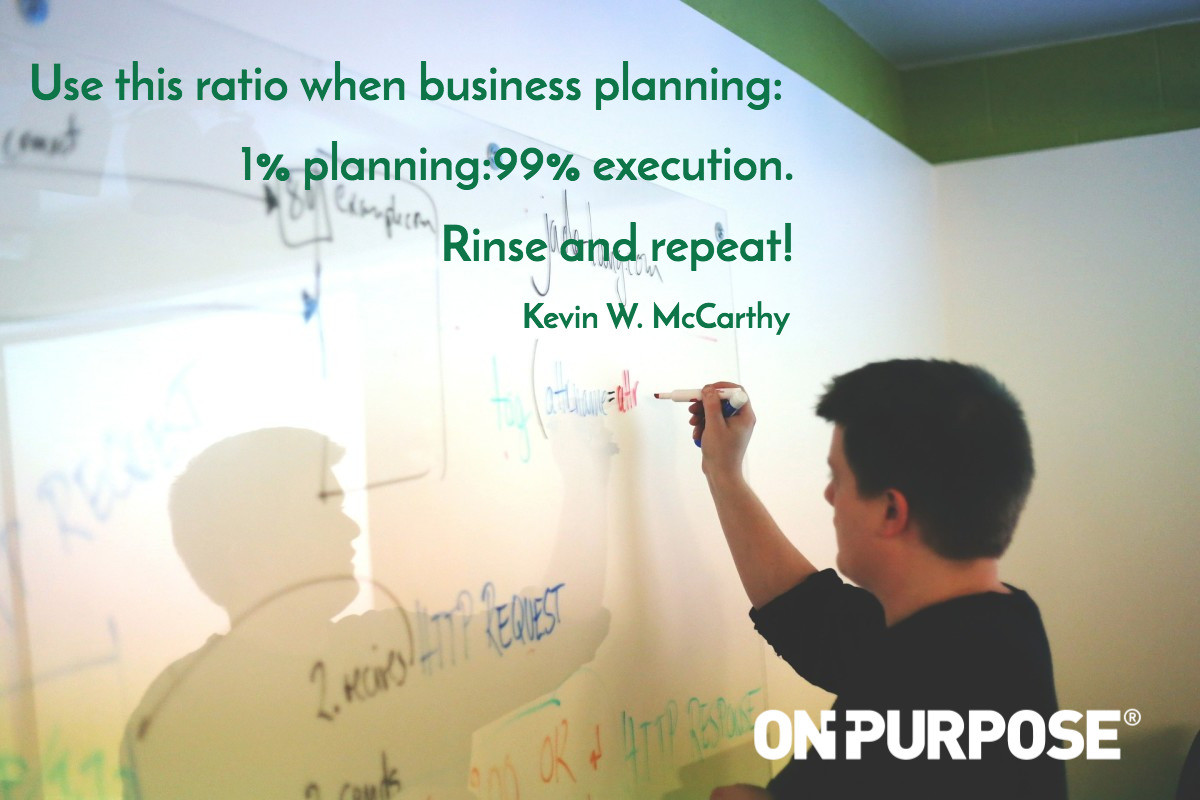
The problem isn’t with the business plan, per se; it is the speed of the person creating the business plan which makes it irrelevant to the business. Most business owners aren’t skilled as business plan writers so their mythologies and misgivings are often unfounded in reality. Speed Use this ratio when business planning: 1% planning: 99% execution. Rinse and repeat!comes with experience and practice.

Too many times, I’ve heard business owners lament that they don’t have time to do a business plan. Hint: maybe the reason they don’t have time is because they’re not working from a plan. That’s more a comment about their limited skills, experience, and understanding or unwillingness to get help.

60-Minute or Less Simple Planning Method

Consider the old adage, “If you have only a day to cut down a tree with an ax, then invest time sharpening the ax before you begin.” Let me add: Continue to check and sharpen it throughout the day. A business plan is a sharp ax that you can take to the forest of business challenges you face and make progress faster, more affordable, and with less energy … sounds like profits to me!

Pull out a blank sheet of paper, go to a whiteboard or flip chart, or open an electronic file to capture your thoughts. Do the brain dump! Then sort it out into a more coherent and logical flow of actions steps. Assign people and dates and you’re ready to go!

A simple idea-clarifying informal business plan can often be done in less than 60 minutes. Practice the following method on smaller projects where the risk, scale, and scope aren’t so large. Practice the process on less demanding content and matters and you’ll be preparing for writing the business plan for the entire business.

Who Are You Fooling?

I’ve even been told by business owners, “A business plan isn’t relevant to my business.” There may be a good reason why business planning is often put aside, but dismissing it as irrelevant is risky business. While creating a business plan is something every entrepreneur or CEO is wise to do, they often don’t. It is a unique skill set that they don’t invest time in learning how to do. In their minds, it seems to be an exercise for the academics and not for people of action.

Reconsider what the pros do.

For example, your favorite NFL team has a plan for the franchise, the season, and a game plan and playbook going into every game for every week of the season for as long as they’re winning into the post-season. They’re professionals who have learned to crank out a “business plan” for every week. To get the results they seek they don’t have an option. Even then, games will be lost. Lessons learned and personnel trained to improve.

Action, even well-intended actions, without a purpose and a plan incrementally lower the trajectory of achievement.

Business planning, hey, it’s optional. That’s a dangerous mindset fraught with avoidable pitfalls. Running by the seat of one’s pants can become a way of life and business. Could this be part of the explanation why the failure rate of small businesses is so high?

Candidly, if taxes didn’t have to be paid, I wonder how many small business owners would have a financial and accounting system in place! Because the IRS likes to be paid and has means of enforcement to be paid, bookkeeping and accounting are done because outside consequences exist. Because business planning is “optional,” it is too easy to not get it done.

So what is the purpose of a business plan?

It helps to know that there are three broad types of business plans:

  1. Financing business plans are done to obtain financing from either investors or lenders. These business plans tend to be formal and time consuming because of the scrutiny of due diligence. Most business planning software leans in this direction.
  2. Functional business plans are more operational or oriented towards helping team members get on the same page to move the business forward. These blueprints for the business are informative and best used for internal use, direction, and communication.
  3. Strategic business plans are very useful, for example, for taking your business ideas and transforming them into a business model. These can be very informal—notes on a yellow pad or napkin—to PowerPoint presentations to more formally written documents.

Audience Matters

Who is going to be reading your business plan and why? Your need for a business plan really depends upon the audience for whom it is written.

  • Financing business plans are targeted toward outsiders to attract investment.
  • Functional business plans involve engaging the team. There is a certain amount of assumed inside knowledge.
  • Strategic plans are best written for the leader of the plan to gain insight and clarity. This enables the entrepreneur to capture thoughts and sort the various elements of a business into an orderly approach.

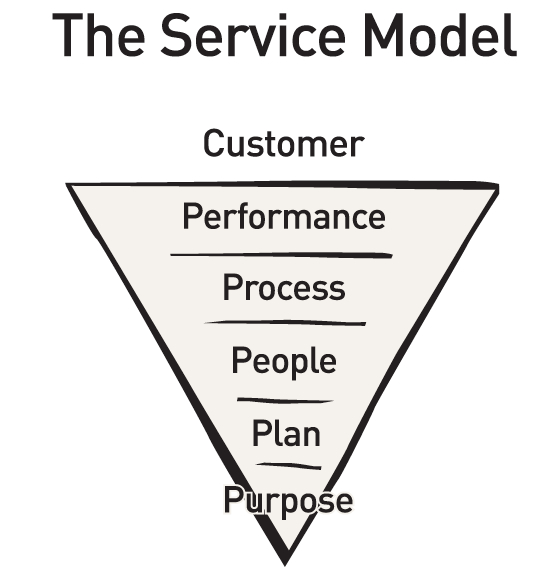
6a00e551c6499c883401a3fd37e903970b.png.jpgEach of these business plans has common elements that you’ll find layered in The Service Model™ (see graphic) from The On-Purpose Business Person.

Creating a business plan is something every entrepreneur should do, but you need to know why you are writing the business plan and the audience.

I’ve seen far too many start-up organizations buy business planning software and invest months writing it. The process of doing their market research, developing cash flow statements, defining their organizational chart, etc. is useful, but is the marginal return on investment worth it? Sometimes you just need to get started and prove your concept in order to improve your business model.

Practically, it is rarely as valuable as the benefit of having a simple business plan and getting started. There’s nothing quite like opening the doors on a small scale and learning from the market. This said, if you have only one part of a business plan to get right—put together your business marketing plan.

Planning is not about perfection.

Rather it is about anticipating pitfalls and avoiding them, as well as leveraging opportunities to the max. Plans are meant to save us time, money, and energy. Always consider the ROI (return on investment) for your planning process.

Over the years, I’ve told my clients to use this ratio when business planning: 1% planning:99% execution. Rinse and repeat!

On-Purpose Business Tip: The Service Model from The On-Purpose Business Person provides a simple business plan template to provoke thoughtful inquiry and usefulness.

Are You A Purpose Driven Person?

March 20, 2018 By kwmccarthy

Today, let’s explore the difference between being purpose driven and purpose called.

Let’s start by defining our terms.

What does it mean to be driven?

Mules and horses are driven by the coachman or whip, as he’s called. For many of us it is too easy to get on a track at work and in life, lean into the yoke, and just keep pushing forward day after day trusting that in the end, it all works out for the best. Is this a healthy way to live?

One day we will reflect and look back over days, years, or decades of being a driven person. We’ve been pushed from behind, compelled to do something that may not be the right fit for us. Often we’re motivated by influences outside of ourselves. Such extrinsic motivation works for a while but it is hard to sustain.

To be called is to answer to a higher power.

It is ours to respond to the calling or ignore it. Most of us think of clergy as having a calling. In fact, every person has a calling, a purpose, a design and gifting that is uniquely fitted into a neat package called YOU!

Purpose CalledWe are not purpose driven. We are purpose called.

Instead of being driven, what if you were leaning into your calling? It may be the same load, but we’re choosing to accept the burden differently.

Here’s a secret about your calling.

You have to be still and listen. It is a calling, not a shout or a holler or a scream. It is subtle, gentle, a small still voice in the wilderness that is never demanding or pushy.

Implied in being called, is being called by name. In a manner of speaking, your 2-word purpose is your spiritual name. So when you hear or recognize it, you know you’re being called and you can answer it.

God calls us by name.

Purpose is one’s identity or name that God uses to call us. We then offer a response of yes or no. When we say yes to our purpose, we are being on-purpose or answering our call.

Here’s a great article on the difference between a job, career, and vocation from Fast Company magazine founder, Alan M. Webber. I remember reading this article in 1998 and nodding my head in agreement.

Watch today’s On-Purpose Minute. You may find it alarmingly disturbing to your “well-ordered life.” Perhaps you’ll find it amazingly comforting as you pursue a calling that seemingly defies logic and reason to everyone except you.

Have you heard about Type A Personalities? These men and women have traits in their personalities that thrive on stress, pressure, multitasking, and … (drum roll) premature death due to heart attacks, high blood pressure, and other stress-induced diseases. Being a driven person and exhibiting Type A behaviors are related but it need not be a death sentence.

Are you ready to begin the cure from being purpose driven?

Here it is: it has nothing to do with your personality—Theory A, B, X, or Y. It has to do with your worldview. You’ve adopted or adapted to a driven personality style.

The cure is to recognize that you are called, not driven. Your purpose forms the words of your identity by which you are called and, once known, you are better capable of recognizing and appropriately responding to your call.

Please let me hear from you. Share your story in the comments section below and you’ll be putting voice to your thoughts and desires. More importantly, others will read your post and glean insights and better self-awareness. You can make a difference this way that can alter the course of another person for good.

Be On-Purpose (called, not driven)!

Kevin

P.S. I’m often asked what I think about Pastor Rick Warren’s best-selling book, The Purpose Driven Life, which came out many years after the original release of The On-Purpose Person. First, no he didn’t “steal” my stuff. I get that question all the time. Second, we use purpose differently. He uses purpose to describe what are really the five missions of the church. He hasn’t asked me to re-title the book, but if asked, it would more properly be named “The Mission-Driven Life.”

Are You Thinking?

March 13, 2018 By kwmccarthy

How often do you really stop and think?

There are many benefits to taking a few minutes to simply ponder your task, project, or life.

The concept of being on-purpose is to act with more intention by being mindful of who you really are.

To know who we are deep down in the heart of our hearts requires thought and demands decisions more easily put off than addressed. But, of all that happens in the world, the one person we can’t ignore or put off is ourself. Sooner or later we will confront the person who has assumed our true identity because we weren’t willing, didn’t have the tools, or didn’t have the guidance to truly think about our lives in more robust terms.

This On-Purpose Minute invites you to simply think. So right after watching this … invest a few minutes to think about whatever comes to mind where your thinking could truly advance your agenda.

Need some help with thinking about your life?

Contact me at kwmccarthy@on-purpose.com and let’s begin the process of thinking about your life so you, too, can be an on-purpose person in creation.


#UNPLUG: This article in Fast Company Magazine speaks about the benefits of getting away from our electronics—you know, the one you’re reading this on!

Arthritis of the Mind


From the keen mind of my friend Mel Kauffman …

William James said, “People don’t think, they just rearrange their thoughts.”

Arthritis of the Mind

Too many people I know have arthritis of the mind. It hurts when they think. Too many people have their minds frozen in mediocrity. It hurts when it defrosts. Most people are opinion parrots. They parrot the opinion of others. That does not seem to pain their brain. Arthritis of the brain is contagious. You catch it from your parents. You catch it from your peers. For many, an original thought is an anomaly. Someone asked Abe Lincoln why he read so much. His response was a light bulb moment for me. He said, “My brain itches and I have to scratch it.” Mark Twain lamented, “We should take our brain out once in a while and jump on it. It gets all caked-up.” William James was so insightful when he wrote, “Most people don’t think, they just rearrange their thoughts.” Thinking is like a muscle. The more you flex it, the more it expands. As brain–pain dissipates, original thoughts begin to appear. Why not leave a legacy of original thoughts?

Mel Kaufmann

melvinkaufmann@gmail.com

  • « Go to Previous Page
  • Page 1
  • Interim pages omitted …
  • Page 4
  • Page 5
  • Page 6
  • Page 7
  • Page 8
  • Interim pages omitted …
  • Page 10
  • Go to Next Page »

Footer

Search this site.

  • Making Meaningful Money™
  • Leadership Mettle™
  • Booking Kevin
  • About Kevin
  • Endorsements

Copyright © 2026 · Kevin W. McCarthy, Winter Park, FL